
E
Understanding Cause and Effect
Child understands and explores the causes and effects of actions and events.
0–9 months – See this age across all domains Infants
What educators might observe
- After dropping an item, looks for or turns body toward item
- Acts on an object to make a pleasing sight, sound, or effect (e.g., shakes rattle to make sound)
- Moves body in a rocking motion in order to get the educator to keep rocking them
Ways educators might support the child's development
- Imitate the baby’s laughter, singing, smiling, and squealing to show that their action produces a reaction
- Position the baby so their kicking and grasping can produce a response
-
Provide a variety of interesting objects for the baby to touch, hold, bang on, and throw
- Various rattles
- Bells
- Small and large drums
- Boxes
- Balls
- Respond to the baby’s efforts to create an effect; for example, if the baby raises their hand to be picked up, say, “You are raising your arms to show me you want to be carried. I’m going to pick you up now.”
8–16 months – See this age across all domains Infants
What educators might observe
- Watches for reactions from other people when an event has occurred, such as an adult answering the phone when it rings
- Repeats actions many times to cause an effect, such as dropping an object for a caregiver to pick up
- Puts objects into a container, turns it over, watches the objects fall out, and then fills it up again
- Approaches objects with an intent to cause a certain effect (e.g., pats a drum, twists a knob, turns on a light switch)
Ways educators might support the child's development
- Respond promptly to the child’s efforts to initiate an interaction, for example, if the child makes eye contact with the educator and then covers their eyes, the educator may say, “You want to play peek-a-boo.”
- Push children on a swing so the motion of going away and coming back supports their developing sense of prediction
15–24 months – See this age across all domains Toddlers
What educators might observe
- Examines toy if it is not producing the desired effect, or tries new ways to manipulate toy
- Knows that playing with certain forbidden objects will get adult’s attention
- When radio is turned on, says, “Dance, Mama.”
- Builds a tower of big cardboard blocks and then knocks it down to watch it fall
Ways educators might support the child's development
- Help the toddler understand the effects of their actions on others (“The baby is smiling because you are talking to her.”)
- Provide cause and effect toys and experiences, such as water and sand, toys that sink and float, ramps and toys with wheels
-
Provide materials that encourage children to explore cause and effect
- A ramp to roll objects down
- Cardboard rolls to push objects through
- Push and pull toys
- Pinwheels
- “Busy boxes” that have various buttons and latches on each side
24–36 months – See this age across all domains Toddlers
What educators might observe
- Says, “She needs her blanket,” when a peer becomes upset
- Says “shhh” and tiptoes when a child is still sleeping
- When a child has a Band-Aid, other child points at it and asks what happened
Ways educators might support the child's development
- Narrate what may be happening during an event that the child is curious about
- Use the phrases, “I wonder...” and “Let’s see what happens if…”
- Allow child plenty of time and repetition to explore an event or item; add materials to extend learning such as different size balls to roll down a ramp
3-year-olds – See this age across all domains Preschool
What educators might observe
- Asks “why” questions to show effort at understanding causation
- Explains the effects that simple actions have on objects (“It will be dark when you turn out the light.”)
- Sees themselves at the center of causation (“I have my own moon. I bring it with me wherever I go.”)
- Offers magical explanations of causes (“The frost fairy came in the night and turned the grass white.”)
- Assigns human characteristics to inanimate objects (“The leaves fell off the tree because the wind told them to.”)
Ways educators might support the child's development
- Encourage children to explain their thinking about magical causes without correcting them
- Engage families in observing and recording their children’s poetic descriptions of causes
-
Offer simple experiments that develop children’s understanding of cause and effect
- Color mixing
- Ramp play
- Objec ts frozen in ice
4-year-olds – See this age across all domains Preschool
What educators might observe
- Uses clues and background knowledge to find causes (“She’s wearing a coat so it must be cold outside.”)
- Identifies objects or conditions that affect other objects (“The food coloring makes the water blue” or “The cold turned the water to ice.”)
- Makes predictions, sometimes using unrelated information (“I think the gold car will win. Gold is for winners.”)
- Uses the word “because” to show relationship between past and future events
- Distinguishes between some magical and scientific causes, but still believes in magical causes
Ways educators might support the child's development
- Engage children in extended back-andforth conversations about the reasons for things
-
Use phrases such as
- What do you think will happen when…?
- What happened last time?
- What made that happen?
- Why do you think that?
- Observe and record children’s hypotheses about causes, and revisit predictions with children to reflect on how their thinking has changed over time
5-year-olds – See this age across all domains Preschool
What educators might observe
- Predicts an outcome based on previous effects they have observed (“If we leave the seeds on the top of the dirt, the birds will come eat them.”)
- Seeks but does not readily accept scientific causes for things
Ways educators might support the child's development
-
Provide materials and opportunities to observe cause and effect
- Blocks
- Marble runs
- Gears
- Paints
- Planting
- Powders for mixing
-
Ask children “what if” questions
- What if we took the bottom block out first?
- What if we add more water to the corn starch mixture?
- What if we add more red to the purple color paint you mixed?
6-year-olds – See this age across all domains Early elementary
What educators might observe
- Believes their own theory about the cause of an event, regardless of the evidence
- Discusses how rules impact people and the environment (e.g., recycling)
- Reflects on how some actions can help others feel better (e.g., cheering up a sad friend by sharing their snack)
Ways educators might support the child's development
- Ask children why the water in a clear or open container left on the heater or windowsill diminishes over a few days
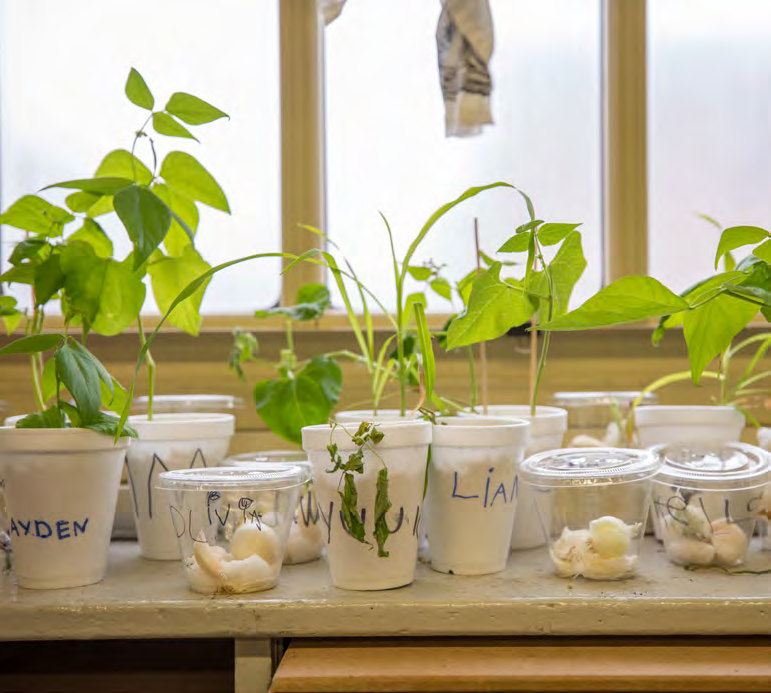
- Plant beans in a plastic bag lined with a wet paper towel; ask why some grow and some do not
7-year-olds – See this age across all domains Early elementary
What educators might observe
- Designs experiments that will prove their previously held beliefs about causes, rather than objective experiments
- Describes choices people make based on availability of resources (e.g., talks about how lack of food causes migration)
- Asks questions about how things change over time
Ways educators might support the child's development
- Engage in group conversation about children’s theories of causation
- Analyze choices people made in creating the built environment (e.g. ‘Why did engineers choose to build a vertical lift bridge here?”)
8-year-olds – See this age across all domains Early elementary
What educators might observe
- Demonstrates understanding of how humans have affected the environment and how actions and rules are adopted to protect the environment
- Discussing the purpose of tools (e.g., how windmills produce clean energy)
Ways educators might support the child's development
- Create opportunities for children to see how changing certain factors causes a predictable change in outcome
- Teach children about climate change and engage the class in analyzing and reducing the group’s use of carbon