
C
Memory and History
Child develops the ability to store, retrieve, and share information about past experiences.
0–9 months – See this age across all domains Infants
What educators might observe
- Can anticipate familiar activities (e.g., kicking legs and cooing when shown bottle, nipple, or spoon before feeding)
- Turns toward the front door after hearing the doorbell ring
Ways educators might support the child's development
- Keep daily schedule constant, while also responding to everyday needs; talk to the infant about what may be happening next
- Verbally express when the infant is gazing at a certain object, such as a door after their caregiver has left (“Oh, I see you looking at the door. I bet you are looking for your Mama. She will return after naptime.”)
8–16 months – See this age across all domains Infants
What educators might observe
- Remembers information about recent event (e.g., continuing to play peek-a-boo after caregiver has stopped playing)
- Uses gestures or single words for a family member after morning drop-off (e.g., going to the door and saying, “Mama?”)
- Imitates actions that they have observed in the past (e.g., watching caregiver blow on hot food before eating, then blowing on own food–hot or cold)
Ways educators might support the child's development
- Create opportunities for repetitious play so that the child will say, “again,” and be willing to play the same game repeatedly
- Have designated places to put things; include pictures on the shelves to remind children where objects go
- Document everyday play in pictures and create photo albums or displays at child level; spend time talking with children about the pictures
15–24 months – See this age across all domains Toddlers
What educators might observe
- Knows where familiar objects are stored (e.g., looks at the shoe bin when educator says, “We’re going for a walk, where are your shoes?”)
- Gives another child an object that belongs to them
- Acts out caregiving sequences within dramatic and pretend play (e.g., breastfeeding a doll and then pretending to burp it)
- Anticipates, acknowledges, and participates in the steps of caregiving routines (e.g., after eating says, “All Done. Wash Hands”)
Ways educators might support the child's development
- At pick-up, talk to families about the child’s activities with the child present so that the family may extend the conversation after school
- Observe the child’s dramatic play and help them make connections (“You are pretending to feed your baby just like mommy does with your sister.”)
- Use songs, chants, and verbal cues to help children learn what comes next in caregiving routines
24–36 months – See this age across all domains Toddlers
What educators might observe
- Recreates experiences in dramatic play (e.g., after going to the grocery store, pretends to put food in a cart and check out)
- Tells about a significant event they remember from the past, such as a time they jumped in a big puddle
- Shares information about recent experiences with trusted adults (e.g., telling a family member about the bee at the school playground)
Ways educators might support the child's development
- Provide the child with photographs or objects to bring home to inspire family conversations about what the child did at school
- Discuss previous events if the child brings them up, such as a trip to the grocery store or a bus ride to school
- Provide props so that the child may reenact their experiences
- If multiple children are remembering a past experience, acknowledge each story, but also point out details such as the time of day, or who they were with
3-year-olds – See this age across all domains Preschool
What educators might observe
- Uses time-related words and concepts (e.g., first/last, morning/night, yesterday/today), though not always accurately
- Although the child’s birthday was a month ago, they may describe looking forward to their birthday, which they tell an educator “is coming soon.”
- Uses phrases that suggest awareness of the past (e.g., “When I was a baby…”)
- Identifies changes in themselves over time (“I’m bigger now. I don’t wear diapers anymore.”)
- Retells a simple story or event in roughly sequential order (“Gabby took my soccer ball. I took it back. That’s why she’s crying.”)
- In dramatic play, reenacts everyday experiences and events from books, television, or observations
Ways educators might support the child's development
- Invite families to share photographs of the child when they were younger, or of past family events; use these photographs to have conversations with the child about their memories
-
When recounting events, use visual representation
- Artifacts, such as a ticket
- Art made by the child
- Photographs related to the experience
- Natural objects, such as shells or leaves
4-year-olds – See this age across all domains Preschool
What educators might observe
- Reenacts multiple sequential scenes from personal experience, books, and media
- Includes specific details of events when recreating them (e.g., pretending to add turmeric and paprika when cooking in the sand box)
- Knows significant events from their family history (e.g., “Abuelito came from the Dominican Republic.”)
- Describes significant changes in their own lives over time (e.g., “I used to live with my Auntie. Now I live in Mommy’s house in Buffalo.”)
- Understands that things were different a very long time ago, but is unsure how long ago this was (e.g., “When grandma was little, were dinosaurs alive?”)
Ways educators might support the child's development
- Observe and reflect on children’s dramatic play; what personal histories are they are re-enacting?
- Invite children to use drawing and dictation to tell about recent experiences
- Create a schedule of the day and support discussion about what comes first and what comes next during the day, as well as what usually happens on what days of the week
5-year-olds – See this age across all domains Preschool
What educators might observe
- Retells an important life event in sequential order (e.g., draws a picture about something they did during summer vacation)
- Believes that they can remember much more than they really can
- Describes how memory works (e.g., says, “It’s easier to remember something that happened yesterday than something that happened last month.”)
Ways educators might support the child's development
- Support the child in making a timeline of their life
- Write a book, About my Life , with pages of stories about what happened when they were a baby, a toddler, and more recently
- Draw a picture of what life was like at a different time, such as before a sibling was born or before they moved
6-year-olds – See this age across all domains Early elementary
What educators might observe
- Begins to understand that history describes the collective memories of people and events from other times and places
- Asks questions of elders about how life was different in the past
- Shares significant events from their own family history with peers
Ways educators might support the child's development
-
Include books in the learning environment that tell stories from history
- Histories of the children’s national and cultural groups (e.g., history of Taíno people)
- Biographies (e.g., Obama, Lincoln)
- Stories of historical events (e.g., The March on Washington)
- Descriptions of life at different periods of history (e.g., prehistoric man)
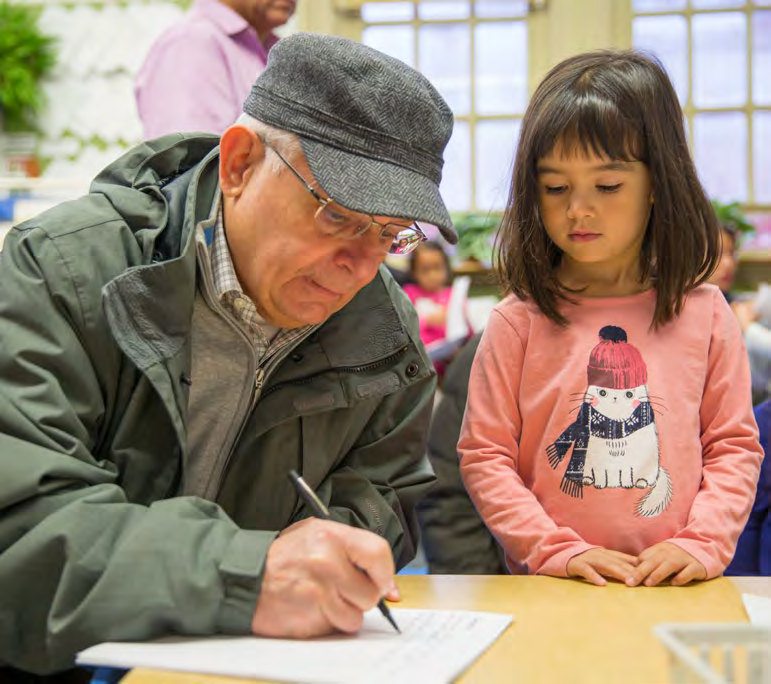
- Invite elders to the classroom to talk about their memories
7-year-olds – See this age across all domains Early elementary
What educators might observe
- Groups items they have to remember into easy-to-remember categories (e.g., animals, foods, shapes)
- Begins to identify which events happened long ago and which happened in the more recent past
- Starts to make connections between how history has shaped our present experience (e.g., “My friends and I can swim at the same pool because of Martin Luther King, Jr.”)
Ways educators might support the child's development
- Research the histories of the national and cultural groups of the children in the class, and be prepared to weave examples from these groups into discussions of history
- Invite each child to contribute to a timeline of a time period that includes now
-
Sing songs that touch on history
- “If I Had a Hammer”
- “If You Meet Me at the Back of the Bus”
- “Fillimiooriay”
8-year-olds – See this age across all domains Early elementary
What educators might observe
- Intentionally selects and uses organizational strategies to remember information
- Uses language to describe chronology, such as “decade” and “century”
- Uses resources such as books and websites to organize information into a chronological sequence
- Connects their family history to broad historical events
- Identifies changes over time in their community
Ways educators might support the child's development
- Use self-talk to describe strategies for organizing information to make it easier to retrieve
- Ask children to write from perspectives of figures they have read and learned about (What was it like to be a knight’s horse, for example?)
- Welcome children to link their family histories to larger discussions of historical events