
D
Investigating and Exploring
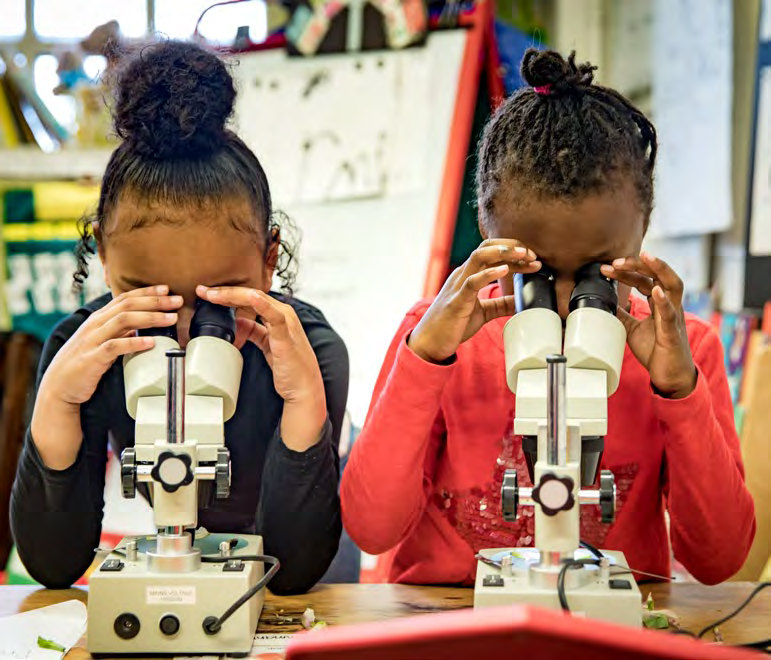
Child becomes a scientific thinker by manipulating objects, asking questions, making observations and predictions, and developing generalizations.
0–9 months – See this age across all domains Infants
What educators might observe
- Child uses senses (sight, smell, touch, hearing, taste) to interact and gain information about people and environment
- Explores objects with hands (grasping object) and mouth (bringing object to mouth)
- Expresses a sense of wonder about their surroundings (e.g., looks at an object or person intently)
Ways educators might support the child's development
- Talk to the child as they look around (“Yes, I see you looking at the teddy. Here you go, you can feel and hold the teddy.”)
- Offer the child objects, name and describe them, and invite the child to inspect the object with hands, eyes, and mouth
- Describe the environment as being rich in sensory experiences (e.g., “Do you feel the sun? Is it warm on your face? Can you see the light? The lights are sparkling.”)
8–16 months – See this age across all domains Infants
What educators might observe
- Brings familiar or new objects they are curious about to a trusted adult
- Laughs at unexpected events, such as when a ball they have rolled up an incline begins to roll back
Ways educators might support the child's development
- Identify and create safe spaces and places for exploring new and different experiences
- Invite children to manipulate objects and feel their texture, weight, and size; this can include pine cones, rocks, leaves, and feathers, for example
-
Join the child in paying attention to sights, sounds, smells, and textures
- Listen to the birds together
- Smell the hotdog stand
- Feel the breeze while swinging
15–24 months – See this age across all domains Toddlers
What educators might observe
- Investigates new phenomena (e.g., when walking past a pile of leaves, stops and feels them with their hands)
- Is curious about items that appear in nature, such as worms, moss, and puddles
- Repeats experiences
- Points to objects and signals to ask what they are
Ways educators might support the child's development
- Bring in natural items, such as bird nests, feathers, and different types of soil
- Provide time for children to investigate objects and experiences during community walks
- Value repetition of experiences as a form of scientific inquiry
24–36 months – See this age across all domains Toddlers
What educators might observe
- Makes guesses about what might happen next based on previous experiences (e.g., pushes doorbell and waits for someone to come to the door)
- Asks simple questions about the natural world (e.g., asks “Where did the rainbow go?” or “Why is it wet outside?”)
Ways educators might support the child's development
-
Engage in multi-sensory activities that invite investigation
- Cooking in the classroom
- Mixing and stirring natural materials in buckets
- Walks in the neighborhood, woods, or park
- Floating scarves in the wind
- Freezing objects in ice and watching them thaw
- Digging holes
- Ask “wh” questions, such as “What is that?” “Who is that?” “What if...?” “What do you think?” and “What happened?”
- Listen to children’s questions and provide descriptive answers
3-year-olds – See this age across all domains Preschool
What educators might observe
- Experiments with mixing different materials together (e.g., sand and water)
- Asks many “why” questions (e.g., “Why do we have to put our jackets on?”)
- Makes simple predictions (e.g., says they think the water in the sprinklers will be cold today)
- Observes and wonders (e.g., watches a turtle and asks, “Why is it hiding inside? When is it coming out?”)
- Applies their knowledge to understand observations (e.g., watches a snail and asks, “Which part are the eyes?”)
Ways educators might support the child's development
- Add natural materials, such as smooth stones or pieces of wood, to different centers
- Conduct simple baking experiments with small groups, such as making muffins or quesadillas
- Ask prediction questions (”What will happen to the flour when the milk is poured in?”)
- Provide access to a sand and water table on a daily basis, and encourage children to mix the substances together
- Use eye droppers to drop different colored oil into water to see what happens
- Acknowledge that when children are asking “why” questions they are not questioning your authority, but needing additional information and trusting you to give it
4-year-olds – See this age across all domains Preschool
What educators might observe
- Uses feelings and imagination to understand the results of a science experiment (e.g., “Maybe the caterpillar just felt like becoming a butterfly.”)
- Uses sources other than the adult to gather information, such as books and peers
- Brainstorms solutions based on background knowledge (e.g., “Be quiet so the birds will come!”)
- Asks a series of questions about their observations (e.g., when observing a worm on the sidewalk the child asks, “Where did it come from? Why doesn’t it have eyes? How will it find its way home to its family?”)
- Asks “why?” but then rejects answers not to their liking
Ways educators might support the child's development
- When a child asks a question, encourage the group to hypothesize what the answer may be; chart their responses and invite them to explain their thinking
- Show children how to look for the answer to a question in a book or online
- Provide opportunities for children to use polls (“Do you think it will rain today?’ “Which item will weigh more-a book, a leaf or a pencil?”)
- Make big graphs to capture this “data” so that children can see and interpret it
- Provide tools to explore the environment (magnets, magnifying glasses, light table)
5-year-olds – See this age across all domains Preschool
What educators might observe
- Asks “how” things were made (e.g., “How does a pigeon build a nest?”)
- Generates ideas about how to find the answers to their questions (e.g., when wanting to learn more about trucks, the child decides to ask a family member who drives a truck)
- Lists materials needed for an experiment
- Records information from an experience (e.g., drawing, writing, storytelling, photographing)
Ways educators might support the child's development
- Model the use of scientific vocabulary
- Ask children to record observations of particular objects and outside scenes such as a cityscape, a tree, a garden
- View wrong answers or explanations as theories in development
- Ask for predictions about observable phenomena (“How do the apples get soft when we make apple sauce?”)
- Provide unique pictures, such as X-rays or close ups of butterfly wings and snowflakes
6-year-olds – See this age across all domains Early elementary
What educators might observe
- Uses non-fiction books to find answers to questions
- Develops hypotheses (e.g., If a hermit crab prefers a particular shell, the child says, “I think it’s because he has more room to grow in there.”)
- Describes a strategy for finding out if their hypothesis is true
- Uses prior knowledge to make generalizations about what might happen (e.g., The child says, “Fruits grow on trees, so I think if I plant this orange seed, a tree will grow.”)
Ways educators might support the child's development
- Use photography to gather observations over time; for example, observe a tree through several seasons or watch a pumpkin over the weeks around harvest, and ask children to come up with theories about why changes occur
- Ask children to do research by looking in books for answers to their questions
- Question the child’s reasoning to explore their thought process, but without concern for correctness (“What makes you think that? How did you figure that out?”)
7-year-olds – See this age across all domains Early elementary
What educators might observe
- Seeks scientific solutions that are rational and consistent and that work in similar situations
- Plans simple experiments (e.g., child builds spinning tops and hypothesizes that a wide top will spin for a longer period of time than a flat one)
- Observes changes in living organisms and the natural environment over time (e.g., independently checks corn plants every morning to see how they are growing)
- Works with peers to collaboratively plan experiments
- Compares their observations to those of their peers
Ways educators might support the child's development
- Provide sketchbooks to record natural phenomena, and make predictions; for example, ask children to draw a seed as they plant it, then when it has sprouted, and as a plant growing over time
- Invite children to document their observations in a variety of ways (charts, notes, or graphs, for example)
8-year-olds – See this age across all domains Early elementary
What educators might observe
- Compares their observations with observations in books and websites
- Poses specific questions and then seeks to answer them through research, experiments, and observations (e.g., child wonders how to make a brick and then reads about the topic and mixes various combinations of materials to see which make the best bricks)
- Identifies and interviews experts to find out the answers to their questions
- Reviews data recorded in tables over several days to draw conclusions
- Starts to understand observations as components of systems (e.g., solar system, digestive system) and identifies individual parts and how they work together
Ways educators might support the child's development
- Invite families to share areas of expertise with the class
- Support children in generating questions for research
- Provide graphic organizers so that children are able to successfully complete a multiday investigation
-
Create role models for children
- Visit scientists at work
- Read about scientists who changed history
- Ensure representation of women and members of non-dominant racial, linguistic, and cultural groups