
Social and Emotional Development
B
Sense of Belonging
Child experiences a sense of belonging in environments that link, extend, and affirm the child’s family and community. Child expresses comfort and joy with human diversity.
0–9 months – See this age across all domains Infants
What educators might observe
- Expresses contentment or joy when trusted adult is present
- Develops cultural identity through daily caregiving interactions, household smell, sounds
- Babbles a range of sounds and imitates intonation and sounds of the home language(s)
- Looks more at faces that resemble the faces of familiar, trusted adults
- May react to and/or interact differently with others who do not resemble their family members and who speak other languages or language variations
Ways educators might support the child's development
- Talk to the family about their caregiving practices and adopt similar practices in the learning environment
- Help families identify, find, and receive supports needed to grow and thrive (e.g., food, housing, mental health resources, and books in the home)
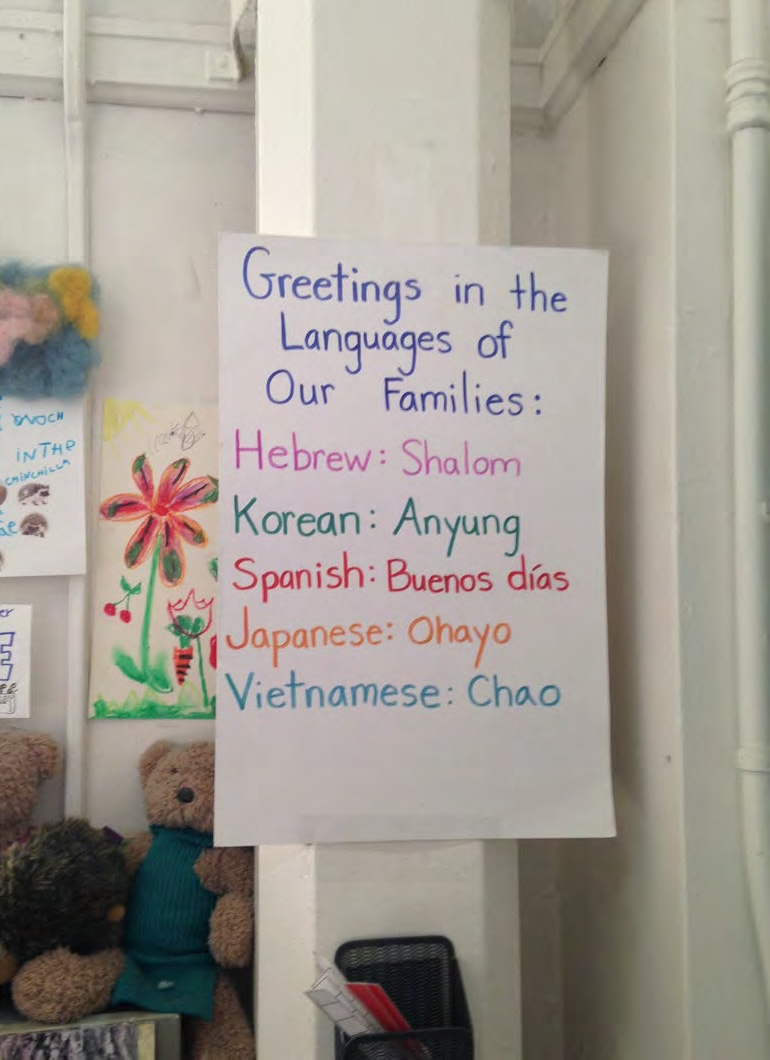
- At a minimum, learn a few simple and essential words, especially greetings, in families’ home language
- Provide opportunities for the baby to interact with all kinds of people by taking them on community walks and introducing them to neighbors
- Express togetherness. Smile when the baby smiles, laugh when they laugh; (“I am happy to be with you.”).
8–16 months – See this age across all domains Infants
What educators might observe
- Plays beside other children
- Demonstrates ease and comfort when spoken to in their home language
- Cries when family member leaves
Ways educators might support the child's development
- Affirm the baby’s choice to seek comfort and care from an educator who shares their racial, linguistic, or cultural background
- Show empathy and acceptance of children’s feelings, and be emotionally close
- Be open to close physical contact with the child; allow children to hold your hand and sit in your lap
- Encourage a sense of belonging within the classroom by having homelike touches, including pillows, pictures of the children’s families (at eye level), comfort items, and a place to hold the child’s belongings
15–24 months – See this age across all domains Toddlers
What educators might observe
- Displays ease and comfort in a variety of places when with familiar adults
- Follows familiar routines (e.g., knows what chair is theirs when meal time occurs)
Ways educators might support the child's development
- Participate in cultural events in the community
- Invite families to make family books or share photo albums of people who are important to the child; keep these in a place that is accessible to the child
- Ensure that the materials in the learning environment incorporate home cultures and introduce diversity through books, posters, and puzzles
- Allow objects that are important to the child and representative of their family, community, and culture to be brought into the learning environment
- Encourage children of all genders to play with a wide variety of toys (dolls, puzzles, dress-up, trucks, etc.)
24–36 months – See this age across all domains Toddlers
What educators might observe
- Identifies self as a member of a family; talks about family members who are not present
- Is curious about physical characteristics of self and others (e.g., skin color, hair texture, or gender anatomy)
- May begin to use social labels such as race to describe people and “match” them based on physical characteristics
- Asks simple questions about other children (e.g., “Where’s Tommy?” “What’s he doing?”)
- May begin to show fear, discomfort, or dislike toward people who look or speak in unfamiliar ways
Ways educators might support the child's development
- Invite families to celebrate the child’s culture and traditions with the group (e.g., family comes to school snack time and serves sushi to children)
- Gently introduce the child to a new learning environment, verbally and physically showing the child items to be played with and places their caretaking needs will be met; allow the child to observe and enter the environment at their own pace
- Point out familiar items or people within the environment (“Look, Susie is here! You played with Susie yesterday with the cars.” “There is a maraca; you have a maraca like this at home.”)
- Facilitate the initiation and inclusion of children in play
3-year-olds – See this age across all domains Preschool
What educators might observe
- Uses pretend play to explore, practice, and understand social roles
- May assign roles to other children during dramatic play that reflect their lived experience (e.g., “You be the Mama, and I’ll be the Papa with the baby.”)
- Identifies gender and other similarities and differences between self and others; may draw conclusions based on stereotypes and personal experience
- Notices differences, and may ask why (e.g., “Why is he in a wheelchair?”)
- Children may begin using their home language in certain places and times or with certain people
Ways educators might support the child's development
- Describe gender as how a person feels (“Josie is a boy because Josie feels like a boy on the inside.”)
- Make the child’s home language seen and heard in the learning environment
- Adapt curriculum and materials in the learning environment so that all children are able to participate
-
Connect families in their learning environment to one another
- Family breakfast in the classroom or program
- Book groups
- Parenting reflection groups
- Encourage families to engage in play-based learning activities in their home language
- Accept silence or quiet observation as an acceptable way for children to participate, particularly when they are new to the learning environment or if that is consistent with their personality
- Reflect on your own biases and the ways those biases manifest in your interactions with children, colleagues, and families
4-year-olds – See this age across all domains Preschool
What educators might observe
- Identifies self as a member of a group (e.g., refers to our family, our school, our faith, or our culture)
- Begins to show evidence of internalized superiority or internalized oppression based on race, ethnicity, class, gender, religion, ability status, family structure, body size, and/or language
- Adjusts behavior to different settings (e.g., family vs. learning environment)
- Compares similarities or differences of others (e.g., height, hair color, or skin tone)
- Seeks out people and objects in the learning environment that affirm their sense of belonging (e.g., educator who shares their home language, family photo, item from home)
- Develops their own theories about what causes differences in ability, gender, and skin color
- May mask fear of differences with avoidance and/or silliness
Ways educators might support the child's development
- Welcome children’s questions about difference (“You are noticing your skin color is different than mine. What words would you use to say what color my skin is?”)
- Include books and materials within the learning environment that respect and honor differences and those by authors of different backgrounds (e.g., culture, gender, ethnicity, language, and abilities)
- Ask families to send in photos of things that are meaningful to each child, such as foods, celebrations, and family activities; use pictures to make personalized posters, displays, and class books
- Ask families to bring familiar objects from their home, such as music, instruments, household items, clothing, and toys, and encourage children to talk about and use them in the classroom
- In non-parochial schools, refrain from celebrating religious holidays, such as Christmas; instead invite families to visit the class and share their cultural traditions
5-year-olds – See this age across all domains Preschool
What educators might observe
-
When a child’s home culture or experience differs from the dominant or mainstream culture, they may
- Reject their home culture and adopt the dominant one
- Reject dominant culture and insist on home culture
- Learn to adjust behavior and to become bi-cultural
- W hen a child’s home culture and experience has been affirmed, they may express pride in their racial, linguistic and cultural identity
-
When a child’s home culture or experience aligns with dominant or mainstream culture, they may
- Internalize a false sense that they are “normal” or superior
- Prefers a child who speaks their own language or language variation as a friend
Ways educators might support the child's development
- Invite family members into the classroom and talk to them as part of a study of families, careers, or interests
- Engage families in conversations about their national and family origins to affirm positive social identities
- Record families telling stories in their home language and include them as part of your listening center/library
- Intentionally plan activities to counter potential overgeneralizations or existing stereotypes
- Engage children in conversation about unfair social differences, including wealth and power
- Model and explain accurate and appropriate vocabulary for different social groups. For example, name your own racial identity.
- Teach children about what causes differences in skin color using books like All the Colors We Are: The Story of how We Get Our Skin Color , by Katie Kissinger
6-year-olds – See this age across all domains Early elementary
What educators might observe
- Shows evidence of social messages affecting how they feel about their self and group identity (e.g., evidence of internalized superiority or internalized oppression)
- Knows that insults related to race, gender, and cultural identity are hurtful
- May choose to play only with children close to their gender, racial, or cultural identities
- Explores the similarities and differences in the home cultures of their peers
Ways educators might support the child's development
- Convey to families that you respect them as their child’s best advocate
- Create opportunities for children to know each other by interviewing each child in a group as part of a name study or family study
-
Incorporate the four goals of Anti-Bias Education (listed below) into the daily curriculum
- Each child will demonstrate self-awareness, confidence, family pride, and positive social identities
- Each child will express comfort and joy with human diversity; accurate language for human differences; and deep, caring human connections
- Each child will increasingly recognize unfairness, have language to describe unfairness, and understand that unfairness hurts
- Each child will demonstrate empowerment and the skills to act, with others or alone, against prejudice and/or discriminatory actions
7-year-olds – See this age across all domains Early elementary
What educators might observe
- Represents themselves as part of racial, cultural, linguistic, or national groups
- Forms groups of friends who share their gender, racial or cultural identities
- Describes how they adjust their behavior between home and the learning environment
Ways educators might support the child's development
- Support a strong classroom community by allowing children to learn about one another informally and formally
- Read stories and books to the class that reflect the diversities represented therein
- Use maps to allow children to locate their homes in the community and their national origins
- Connect families to work together on volunteering in the classroom, on fundraising projects, and chaperoning field trips, etc
- Include community-building games in the daily routine at morning meeting and closing meeting
8-year-olds – See this age across all domains Early elementary
What educators might observe
- Exhibits understanding of larger concepts related to self and belonging (e.g., safety, respect, kindness, and care for objects, self, and others)
- Identifies gender and racial stereotypes in books and media
- Knows some historical facts about their family, community, and culture
- May disengage from learning if they feel like they do not belong at school
Ways educators might support the child's development
- Suggest out-of-school time connections for children; recommend to families of specific children which classmates or afterschool programs may be good matches, and include this suggestion in mid-year reports and meetings
- Create multiple opportunities each week for children to share personal experience with their classmates (e.g., include sharing about their lives or reading aloud personal narratives at daily morning meeting)
-
Provide class-wide opportunities for children to build their own social context
- Write get-well notes to classmates who are ill for many days
- Make “celebrating you” booklets on children’s birthdays in which each child contributes a note or drawing for the birthday child
- Incorporate social justice into your curriculum, providing opportunities for children to engage in inquiry and action around social issues that they care about in their community