
4
Spatial Sense and Geometry
Child understands how objects, points, lines, and shapes fit in space.
0–9 months – See this age across all domains Infants
What educators might observe
- Looks at own hands and feet as they move through space
- Watches a ball rolling away after accidently knocking it
- Observes a ball bounce up and down
- Uses vision and hearing to track the path of someone walking by
Ways educators might support the child's development
- Provide comfortable, safe space for the child to move freely on the floor
- Provide materials of various sizes and shapes for the child to explore, such as different types of fabrics, silicone muffin tins, ice trays, or metal jar rims
- Present collections of balls
- Use vocabulary related to spatial awareness (e.g, “in,” “on,” “under,” “up,” “down,” and “to”)
8–16 months – See this age across all domains Infants
What educators might observe
- Attempts to roll body over
- Puts smaller object inside larger one, such as placing small toy in a bucket
- Uses trial and error to play with objects that can fit inside openings (e.g., tries to put different sized balls into the top of a large jug)
- Repeatedly puts things in and takes them out (e.g., sticks a peg in a hole and pulls it out again)
- Takes rings off a stacking ring and then puts one or two back on
- Stacks blocks on each other, but may put bigger block on smaller one or try to balance a square on a triangle
- Gets in and out of things (e.g., climbs into a large laundry basket and then climbs back out)
Ways educators might support the child's development
- Encourage pointing at objects, and verbally acknowledge the item that is being pointed to
-
Provide materials in the learning environment that support the development of spatial sense
- Shape sorter
- Nesting cups
- Ring stackers
- Simple knob puzzles
-
Provide collections of objects that are the same shape
- A collection of cubes, including boxes and blocks
- A collection of circles, including rings, lids, and round pieces of paper
15–24 months – See this age across all domains Toddlers
What educators might observe
- Rolls ball back and forth with educator
- Puts together a knob puzzle with two or three separate pieces
- Uses trial and error to place a group of nesting objects, such as boxes of different sizes, inside one another
- Makes a line of blocks next to one another
- Turns a book right side up after looking at the pictures and realizing it is upside down
Ways educators might support the child's development
-
Encourage whole body movement
- Roll in the grass or on the rug
- Crawling, walking, and running over distance
- Kicking, throwing, and rolling balls
- Crawling through tunnels
- Name shapes in the environment
- Take children on community walks along different routes and discuss the landmarks you see; ask children to point to different landmarks at various points along the path
- Provide various size and shaped containers that children can fill with water, sand, or play dough
24–36 months – See this age across all domains Toddlers
What educators might observe
- Matches shapes with similar sizes and orientations
- Completes three or four piece puzzles
- Stacks rings on a post with the biggest on the bottom and the smallest on the top
- Understands words related to position (e.g., “Please put the basket on the table” or “Please get under the covers.”)
- Understands the words “longer,” “shorter,” “big,” and “little”
- Places blocks on one another to make a stack, lining up the edges
Ways educators might support the child's development
- Outline shapes on the floor using string or tape, and encourage the children to go inside
- Provide different sized boxes, wagons, and wheelbarrows that the children can climb in and out of and can use to move objects or other children
- Talk about the shapes of blocks with children; compare the blocks with one another
- Emphasize words describing where objects are in relation to one another (“beside” and “between”)
- Help the child to find themselves in space (“Where is your pinky finger? Where is your elbow?”)
3-year-olds – See this age across all domains Preschool
What educators might observe
- Uses words to indicate direction and position, but not always accurately
- Builds vertical and horizontal components within a block building
- Identifies and names circles and squares
- Calls two shapes the same, if they have similar parts but are not identical (e.g., when both shapes have pointy parts)
- Plays with combining shapes and pulling them apart
Ways educators might support the child's development
- Set up simple obstacle courses with children such as hopscotch, hopping over a hoop, jumping up and down, or twirling with a ribbon, use positional words such as “over,” “under” and “through” as children move through the obstacle course
- Tape shapes on the ground, and ask children to do movements as they go around them
- Name and identify shapes children make while drawing and writing
- Invite children to reach into “feely boxes” and pull out a shape that matches the one the educator is holding
- Identify shapes and angles in everyday life, such as a circles on the tops of cup, rectangular pieces of paper, the angle made when the scissors open, or the angle at the edge of the table
4-year-olds – See this age across all domains Preschool
What educators might observe
- Uses blocks to build in multiple directions, with multiple points of contact between components
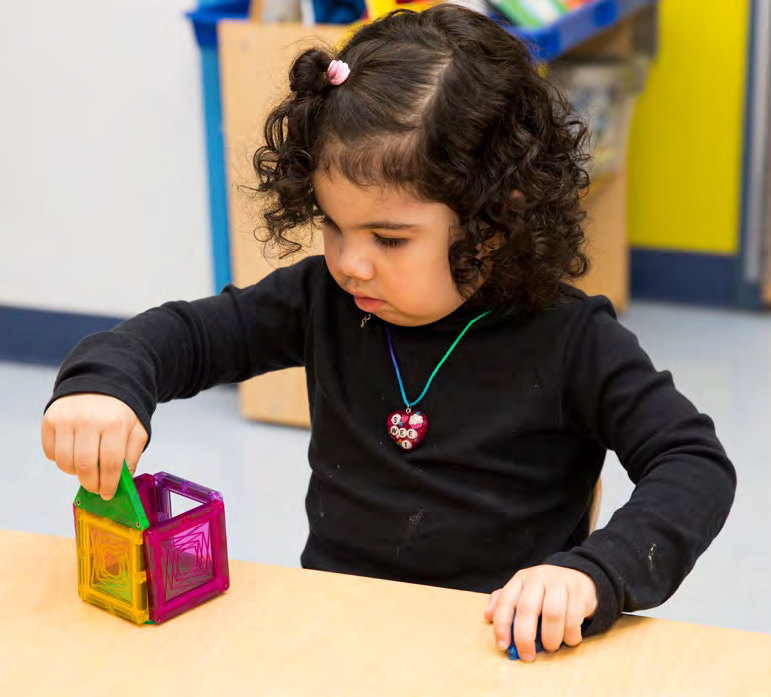
- Builds arches, enclosures, corners, and crosses
- Follows a model to create simple shapes out of lines (e.g., organizes sticks to make a triangle or rectangle)
- Slides and turns pieces to make them fit in a simple puzzle
- Calls a shape a rectangle because it “looks like a door,” rather than naming sides and angles
- Calls a variety of open or closed pointy shapes “triangles”
- Experiments with combining shapes to make a new shape (e.g., in the block area, accidently puts two triangles together to make a square, and then repeats this action intentionally)
Ways educators might support the child's development
-
Include materials in the classroom environment that develop geometric concepts
- Blocks
- Jigsaw puzzles
- Magnetic shapes
- Shape puzzles
- Pattern blocks
- Unit blocks
- Legos
- Go on community walks along different routes and discuss which route was longer or shorter and why
- Describe the location of objects the child is trying to find, rather than pointing to them (e.g., “The tape is beside the construction paper.”)
- Present many examples of squares and rectangles, varying orientation and size; include squares as examples of rectangles (If children say, “That’s a square,” reply, “It is a square, which is a special type of rectangle.”
5-year-olds – See this age across all domains Preschool
What educators might observe
- Correctly uses position words such as “beside,” “under,” and “inside” to describe objects
- Slides, flips and turns pieces to make them fit in a puzzle, but does not always move them in the right direction at first
- Recognizes that there are other shapes that are not common (e.g., rhombus and hexagon)
- Spontaneously creates symmetrical buildings in the block area
- Builds complex bridges with multiple arches, ramps, and stairs at the ends
- Intentionally puts pattern block shapes together to make another shape for a picture
Ways educators might support the child's development
- Invite children to draw maps of routes, illustrating what landmarks will be passed or seen on different routes
- Draw maps of the playground and use them to go on a scavenger hunt
- Challenge the child to cover hexagon pattern blocks with other pattern blocks and see what works
- Introduce vocabulary such as “sides,” “angles,” and “parallel lines”
- Identify and describe the symmetry children spontaneously create in their art work
- Hunt for shapes outside and around the school; take photographs of them and print them out as shape books for the classroom
6-year-olds – See this age across all domains Early elementary
What educators might observe
- Uses maps with picture clues to determine paths and find objects
- Discriminates and names most common shapes, including rhombuses, without making mistakes such as calling ovals circles
- Moves one shape on top of another to check if it fits exactly
- Divides circles and rectangles into halves or fourths to develop understanding of part/whole
- Uses blocks to make complex towers or other structures involving multiple levels with ceilings
Ways educators might support the child's development
-
Look at maps with children and encourages them to describe
- Direction—which way?
- Distance—how far?
- Location—where?
- Identification—what objects?
- Coordinates—what are they?
- Encourage children to make representations out of pattern blocks (for example, a ship with a smoke stack and rhombus-shaped smoke); they may trace their pattern block images to create pattern block puzzles for one another
- Read books by Rebecca Emberly and others that show how to represent objects with different shapes
7-year-olds – See this age across all domains Early elementary
What educators might observe
- Pays attention to the spatial relationships of all the parts of complex figures
- Folds paper squares to make two triangles, folds them again to make more triangles, and describes the process
- Uses simple coordinates to locate a place on a map or a move on a chessboard
- Systematically checks that two shapes are the same by comparing all attributes
- Recognizes and describes situations in which angle knowledge is relevant (e.g., “I need to change the angle to make the car go faster down this ramp.”)
Ways educators might support the child's development
- Invite children to use materials such as clay, straw, and pipe cleaners to construct shapes
- Encourage children to describe why a figure belongs or does not belong to a shape category
- Show children how to “test” right angles on rectangles with a “right-angle checker,” (thumb and index finger held apart at 90°, or the corner of a piece of paper)
-
Solve construction problems with blocks
- Build a bridge from point A to point B
- Construct the tallest tower
- Attempt to build buildings observed in the neighborhood
8-year-olds – See this age across all domains Early elementary
What educators might observe
- Uses maps to follow routes, even when they don’t have pictures or the distances are not accurate
- Mentally moves shapes and says what they need to do to make them fit into a puzzle
- Names the class of shapes explicitly based on properties, including angle measure
- Sorts shapes hierarchically, based on properties
Ways educators might support the child's development
- Create realistic and abstract art using shapes, lines, and understanding of orientation of those things on paper
- Observe the use of shapes in artwork from different cultures, drawing attention to the cultures of the children in the class
- Describe the properties of a shape and invite the children to name that shape
- Place shapes in a category, and ask children to name the reason for the classification