
0–9 months – See this age across all domains Infants
The guidelines don’t define behaviours for this area at this age.
8–16 months – See this age across all domains Infants
What educators might observe
- Rolls a toy car back and forth on the floor
- Uses two objects that go together to pretend (e.g., puts a spoon in a bowl and stirs)
- Uses a bottle and pretends it contains a favorite drink (e.g., “leche”)
Ways educators might support the child's development
-
Provide materials for the child to imitate caregiving routines
- Doll stroller
- Brush or comb
- Bottle
- P lay games with a script (“Where is Mommy?” “There is Mommy!” “Where is baby?” “There is baby… there you are!”)
15–24 months – See this age across all domains Toddlers
What educators might observe
- Substitutes similar objects in dramatic play (e.g., uses a block as a phone)
- Imitates a few steps of adult behavior in dramatic play (e.g., puts doll in bed and says, ‘night-night.’)
Ways educators might support the child's development
- Talk with families about the way they use storytelling, song, theater, and art in their home and community
- Make play dough with the child and use household objects such as wooden spoons or cookie cutters
- Use music to enhance the telling of stories
24–36 months – See this age across all domains Toddlers
What educators might observe
- Uses objects flexibly for symbolic play (e.g., a stick becomes a spoon then a wand; a box is a boat then a house)
- Animates and interacts with objects (puppets, toys, sticks, or dolls) as characters who speak aloud and have feelings
- Talks to self during dramatic play even when no playmates are around
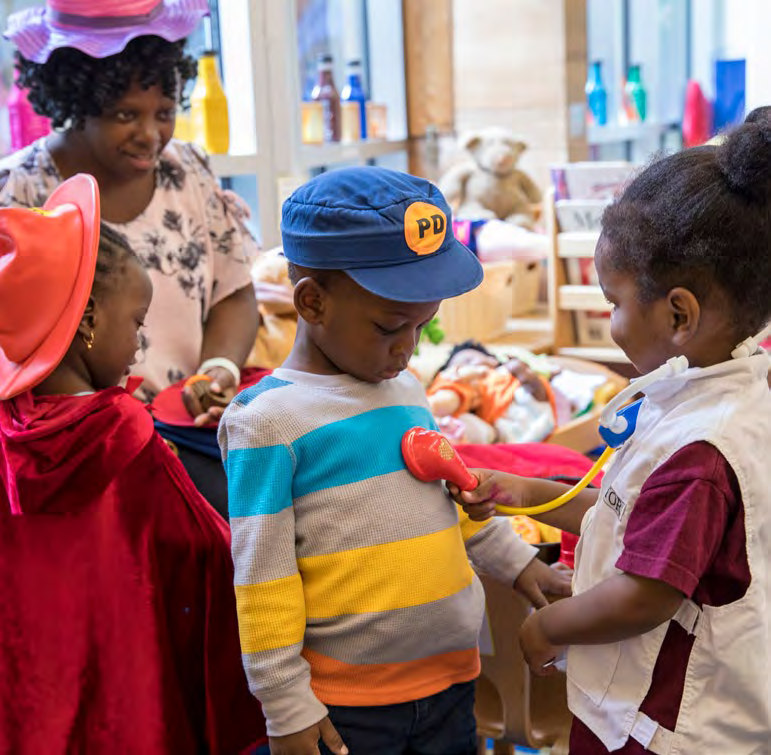
- Completes a series of actions related to a theme in dramatic play, such as listening to a doll’s heart, then giving the doll a shot and a bandage
- -Makes marks on paper and says they represent something (”I drew Mommy.”)
Ways educators might support the child's development
- Provide fabrics and props for the child to use in dramatic play so they can create scenarios
- Encourage child to talk about or point to specific parts of their drawings, paintings, and sculptures by saying, ”Tell me about your…” or “Oh, you are pointing at a red tree!”
3-year-olds – See this age across all domains Preschool
What educators might observe
- Assigns peers, adults, or objects roles as characters in play
- Plans with other children what they are going to pretend before starting to play (e.g, “Let’s play doggies!”)
- Uses objects to make arrangements and represent a storyline; may repeat the story over and over again (e.g., uses blocks to make a house, then uses a toy fire truck to put out a fire in the house)
Ways educators might support the child's development
- Ask child what would help further their play, such as what other materials they could use to represent something
- Read familiar stories such as The Three Billy Goats Gruff many times and encourage the child to act it out
- Reflect with children about their dramatic play, and talk about the different roles in a family, while being mindful of different kinds of families and cultural differences; what does it mean to the child to act like a mommy, daddy, aunt, grandma, or other family member?
4-year-olds – See this age across all domains Preschool
What educators might observe
- Constructs and experiments with longer, complicated storylines in dramatic play
- Invents storyline and initiates play with a peer (e.g., “Are you coming to my restaurant? Can I take your order?”)
- Negotiates roles with peers (e.g, “I’ll be the papa and you are baby bear.” “NOOO. I’m the sister bear. And you are my brother.”)
Ways educators might support the child's development
- Invite families to visit the class to share a folktale or family story
- Encourage the child to add details; for example, build a fort to represent an animal’s home, and then discuss what would be needed in the fort to make it more cozy
- Support the development of children’s understanding of gender roles in representation (“What does it mean to look like a girl? Does a girl have to look like that?”)
5-year-olds – See this age across all domains Preschool
What educators might observe
- Adds details from a scene to its visual representation (e.g., the landscape or the weather)
- Differentiates fantasy from reality
Ways educators might support the child's development
- Observe and reflect on children’s dramatic play; consider what background knowledge they are drawing on
- Offer large pieces of materials to be used in different ways, as well as costumes that suggest a role: worker’s hats (hard hat, bus drivers’ hat), vest and suit jackets, dresses, a doctor’s kit
- Ask the child, “What story are you telling?” in their drawing or construction
- Write or help children write a story based on what they drew, acted out, or built
6-year-olds – See this age across all domains Early elementary
What educators might observe
- Assigns roles and acts out scenes from the economy (e.g., child dramatizes a farmer’s market and has peers work at different stalls and be customers)
- Uses art to reflect on their experiences (e.g., uses musical instruments to make a song about an experience they had)
- Shares stories and symbols from their own families and cultures
Ways educators might support the child's development
- Ask families about cultural or religious prohibitions to representation; create a welcoming and inclusive learning environment
- Invite children to use collage materials to make dollhouses out of cardboard boxes and make characters to inhabit the dollhouses
- Sing songs with space for children’s contributions and allow them to write new verses
- Create visual art while listening to different types of music
7-year-olds – See this age across all domains Early elementary
What educators might observe
- Represents specific details from architecture in their constructions
- Plans artistic representation with peers (e.g., child writes a story with friends and then makes puppets and scenery to dramatize the story)
- Experiments with different forms of representation they have learned about through media and trips to cultural institutions (e.g., child attends a field trip to see Balinese shadow puppets and then experiments with creating shadow puppets themselves)
Ways educators might support the child's development
- Invite families to share modes of artistic expression from their family, community, or culture
- Make paper dolls of historical figures; use cloth and scissors to clothe the dolls in historical costumes
- Act out stories that the children write
-
Sing songs, such as:
- “I Had a Rooster”
- “The Cat Came Back”
- “The Foolish Frog”
8-year-olds – See this age across all domains Early elementary
What educators might observe
- Uses research to add realistic details to their representations (e.g., researches costumes from the past to create a dramatization of the life of a historical figure)
- Describes systems for symbolic thinking from the past, such as hieroglyphs
Ways educators might support the child's development
- Notice the particular forms of representation that are motivating for different children
- Encourage children to use art to represent their feelings
- Invite families to join children in creating
- Welcome families to celebrate children’s creations
- Challenge children to create models of villages, replicating complicated architectural details