
Social and Emotional Development
G
Rhythms, Rules, and Routines
Child follows the rhythms, rules, and routines of the learning environment.
0–9 months – See this age across all domains Infants
What educators might observe
- Develops increasing consistency in sleeping, waking, and eating patterns
- Anticipates and participates in routine interactions (e.g., lifts arms toward educator to be picked up)
- Engages in some regular behaviors (e.g., sings or babbles self to sleep; goes to high chair when hungry)
Ways educators might support the child's development
- Develop an individualized routine that is predictable and consistent so that the child learns that their needs will be met; not every child will be on the same schedule
- Assign primary caregiving groups so that an educator does most of the important daily tasks such as transitions, diapering, feeding, and providing comfort
- Respond to child’s cues as soon as possible, and verbally let the child know that you are acknowledging their feelings
- Use words to express what the child is requesting (e.g., “You are starting to rub your eyes, so it looks like you are getting sleepy.”)
8–16 months – See this age across all domains Infants
What educators might observe
- Recognizes that certain adult actions are associated with expected behavior (e.g., waits to be buckled into stroller)
- Anticipates familiar routines or activities (e.g., watches for a family member when it is time to go home)
- Recognizes that different behaviors will elicit different reactions from adults
- Makes eye contact with educator when doing something that is off-limits
Ways educators might support the child's development
- Offer individualized schedules for those children who may need to nap longer or eat earlier than the rest of the group
- Have a consistent routine throughout the day, and prompt child with verbal cues about what may come next (e.g.,“We’re going to change your diaper and then give you a bottle.”)
- Use a positive approach with children; tell the child what they can do, rather than what they can’t do
15–24 months – See this age across all domains Toddlers
What educators might observe
- Begins to assert self by resisting educator requests
- Reaches to take a toy from a peer, but then pulls back their hand in response to the educator’s look
Ways educators might support the child's development
- Provide appropriate alternatives and substitutes (e.g., “I see you want the baby doll. Can you hold the puppy while you’re waiting?” or “Chairs are for sitting. You can climb on the climber.”)
- Use familiar cues such as dimming of lights, playing music, singing a song, or displaying a picture to indicate a transition
-
When giving a child directions
- First gain the child’s attention
- Use simple language
- Give one direction at a time
- Use positive language (e.g., “Gentle hands,” rather than “Don’t hit.”)
- Give time for children to respond to direction
- Follow through with positive acknowledgement
24–36 months – See this age across all domains Toddlers
What educators might observe
- Follows some consistently set rules and routines (e.g., chooses a book after lunch for quiet time)
- Challenges boundaries and rules while striving for independence
- Experiences difficulty transitioning from one activity to the next
- Can verbally start to tell what comes next in the routines, and helps guide others in different transitions and activities
Ways educators might support the child's development
- Meet with families to discuss the rules in their home. Identify which of these rules families consider cultural values; establish rules in the classroom that provide continuity with the children’s experience at home.
- Agree on a simple set of rules with your team of educators
- Provide time for children to learn and practice rules
- Create a picture schedule and post at the children’s level to help children anticipate transitions; review the picture schedule at the start of the day
- Encourage children to feel ownership of the learning environment; for example, provide access to a small sponge so they can wipe up their own spills
3-year-olds – See this age across all domains Preschool
What educators might observe
- Participates in routine activities such as meal time, snack time, and nap time
- Follows simple rules with few reminders (e.g., handles toys with care, clears plate after lunch, cleans up before moving to another center)
- Begins to follow basic safety guidelines and requirements, such as walking rather than running inside, but may not do so consistently
Ways educators might support the child's development
- Talk with families about their beliefs regarding discipline and how they would like their child to relate to authority figures
- Design the schedule to include a balance of large and small group activities, and active and quiet times
- Design the schedule to minimize the number of transitions in the day and the amount of waiting during transitions; this may involve breaking up the classroom into smaller groups
- Recognize there are individual variations in what forms of acknowledgement are interpreted as positive by children and choose the best fit for each child (e.g., verbal, physical, non-verbal, etc.)
- Provide frequent, clear, and consistent verbal and non-verbal positive feedback
4-year-olds – See this age across all domains Preschool
What educators might observe
- Adapts to changes in daily schedule (e.g., “Today is Wednesday, and we have our art lesson with our visiting artist.”)
- Predicts what comes next in the day, when there is an established and consistent routine (e.g., “After nap we have a snack, then my Mom comes to get me.”)
- Demonstrates understanding of the consequences of own actions on others (e.g., “I gave Anna the toy and so she feels better.”)
- Waits for turn during group activities
Ways educators might support the child's development
- Implement the schedule consistently
- Teach children about the schedule and encourage them to verbally express what comes next
- Teach children the expectations for transition times
- Provide clear verbal and visual warnings prior to transitions
- Follow through with positive acknowledgement of children’s behavior and following of rules
- Provide gentle reminders about rules of different areas, such as the playground and the classroom
- Establish, e xplain, and model simple rules in ways children can understand (e.g., nap time might involve going to the bathroom, seeing the lights go off, getting into bed, and hearing calming music)
5-year-olds – See this age across all domains Preschool
What educators might observe
- Changes actions to meet expectations of different settings (e.g., takes off shoes at home but wears shoes at school)
- Applies familiar rules in new but similar situations (e.g., uses a quiet voice inside)
- Adapts to new environment by behaving and displaying emotions in expected ways (e.g., goes to a new friend’s house and is able to be calm, share, and take turns)
Ways educators might support the child's development
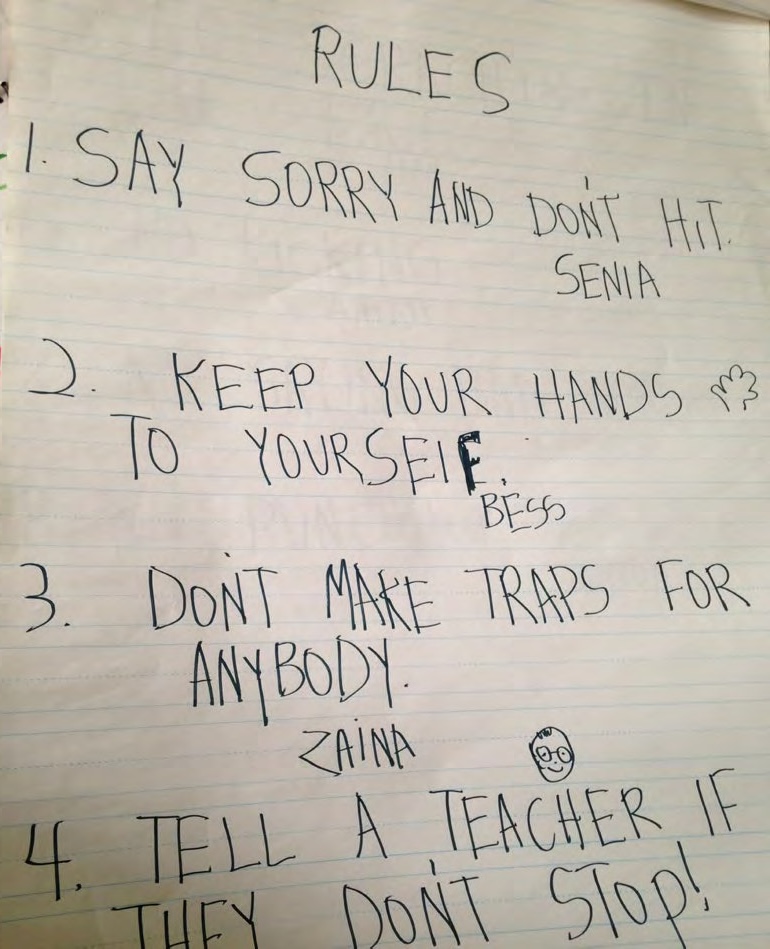
- Create rules that are manageable (3–5 classroom rules around safety, for example), ask for children’s input about the rules, and discuss what makes a strong rule
- Review the rules and classroom expectations regularly, at a time when things are calm
- Post rules in words and pictures
- Enforce rules and consequences consistently and fairly for all children
- Reflect about which children are most commonly disciplined in the learning environment; do these children belong to marginalized groups?
- Reflect with families and colleagues about how children may perceive the educator’s attempts to provide direction (e.g., Educator says, “Would you return to your seat?” and child perceives it as a question rather than a request)
6-year-olds – See this age across all domains Early elementary
What educators might observe
- Adheres strongly to rules (e.g., “James isn’t raising his hand to talk, but I am!”)
- Follows routines with multiple steps independently (e.g., arrives in the morning and knows what to do to begin day: hangs up belongings, takes out their folders, and chooses an activity until group time is announced)
- Takes turns in group discussion (e.g., raises hands, quietly listens to others, and proposes ideas when it’s their turn to talk)
- Adapts rules to fit a particular situation or their own desires
Ways educators might support the child's development
- Reflect on your own cultural expectations related to discipline
- Create some routines together; ask children, for example, how they think an area could best be organized and use their input to create some routine procedures
- Decide on logical consequences for rules with all staff; reconsider the use of social exclusion as a consequence
7-year-olds – See this age across all domains Early elementary
What educators might observe
- Knows the daily and weekly schedule and routines and follows routines accordingly (e.g., time for art, physical education, recess, lunch, etc.)
- Adapts to the majority of a group even when the group’s ideas differ from their own (e.g., group plays a game with rules different from the actual rules)
Ways educators might support the child's development
- Learn from families about rules and routines they have at home
- Create illustrated charts of complex routines, like cleaning up paint or packing up at dismissal
- Sing songs or chants to remind children of steps in a routine
8-year-olds – See this age across all domains Early elementary
What educators might observe
- Understands and follows large concepts or rules regarding safety, kindness, respect, and care within different environments
- Understands the purpose of laws
- Follows rules alone or within a group (e.g., quietly enters or exits building, gym, or library alone or in a group)
Ways educators might support the child's development
- Engage children in reflecting on the origins and intentions of social laws
- Engage children in conversation about social movements to make society more fair
- Invite children to discuss the difference in rules between various cultures, communities, and families