
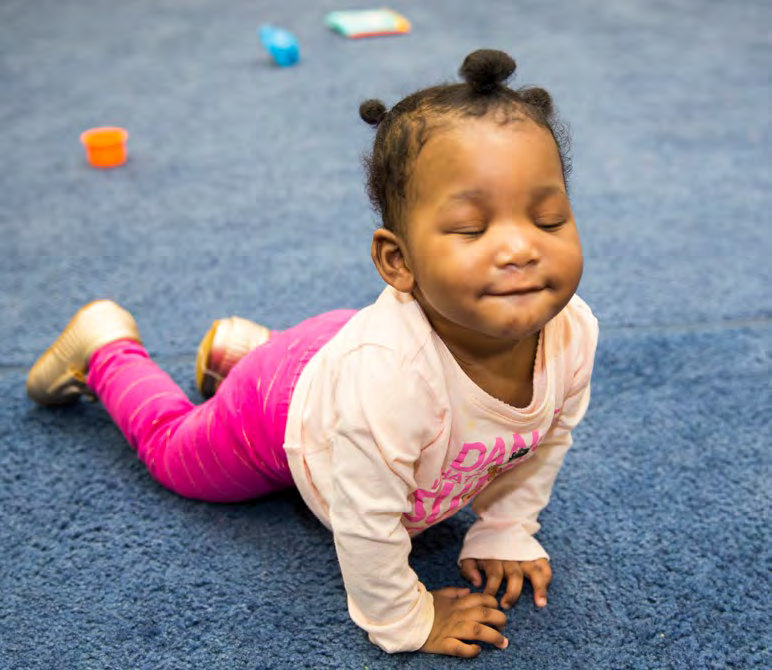
0–9 months – See this age across all domains Infants
What educators might observe
- Actively explores the environment with their senses
- Engages familiar adults in interactions (smiling, approaching, gesturing)
- Rolls or crawls closer to touch an object
- Reaches for something of interest, such as a caregiver’s glasses or a toy
- Tries to hold bottle and feed self
Ways educators might support the child's development
- Allow the child to freely explore the learning environment
- Remove items such as bouncers and electronic swings that restrict a baby’s movement
- Place interesting and appealing materials in the child’s line of sight, so they can choose what objects and materials to move toward and take initiative to explore
- Allow the baby to feel and mouth the books and objects
8–16 months – See this age across all domains Infants
What educators might observe
- Moves toward object or person they are interested in
- Wants to participate in selfcare routines (e.g., wants to hold their own toothbrush)
- Crawls or toddles to an educator with a book they have selected
- Holds objects up or out to educator that they are curious about
Ways educators might support the child's development
- Support the child by using vocabulary that indicates initiative (e.g., “Oh look, yes, you can open the box. What is inside? Scarves. Yes, you are shaking the scarves.”)
- Follow the child’s lead, taking time to stop and examine objects they are interested in with them
- Invite and welcome the child’s attempts to assist with routine tasks such as sweeping the floor and washing the tables, as well as picking up toys
15–24 months – See this age across all domains Toddlers
What educators might observe
- Vocalizes to express desire for an object or curiosity about it, with such phrases as “Dis?”
- Tries activities that their educator suggests they engage in (e.g., goes down the slide after their caregiver suggests it)
- Is inspired by the activities of their peers (e.g., after seeing another child push a doll stroller, tries to take the doll stroller and push it themselves)
- Looks or points at activities that they are interested in participating in
Ways educators might support the child's development
- Build opportunities throughout the day for the child to make simple choices
- Slow down to the child’s pace, showing interest in what they are doing
24–36 months – See this age across all domains Toddlers
What educators might observe
- Finds ways to accomplish their own goals, such as climbing onto a table to reach something up high
- Explores on their own and then returns to educator (i.e., runs to see something that looks interesting to them and then circles back to educator)
- Tells an educator what they want to do
Ways educators might support the child's development
- Engage the child in taking care of their stuffed animals or baby dolls in ways that mirror their self care: washing, diaper changing, trying to use the potty, reading books, and preparing for rest time with a blanket and lullaby
- Allow child to attempt tasks by themselves without doing it for them right away
3-year-olds – See this age across all domains Preschool
What educators might observe
- Engages in solitary play with a preferred toy
- Asks educator to read them their favorite book
- Watches what another child is doing and then begins to do it alongside them
- Chases another child and then turns so that they may have a turn being chased
Ways educators might support the child's development
- Include duplicates of toys in the learning environment so that multiple children can play next to each other simultaneously
- Help children to initiate play by giving verbal cues (e.g., “Your turn! Now it’s Chelsea’s turn, which means that you run and try to catch her!”)
- Involve the child in small group activities where they can contribute, participate, take turns, and anticipate as well as initiate turn-taking
4-year-olds – See this age across all domains Preschool
What educators might observe
- Gathers the materials that they need for a simple project, such as making imaginary soup
- Finds their own clothing in their cubby and puts it on
- Makes a plan for what they want to create (e.g., plans to draw a house)
- Makes a choice about which area of the classroom they want to play in
- Makes a new friend by playing alongside or with them and engaging in conversations
Ways educators might support the child's development
- Discuss with families ways in which children’s initiative is a value in their family, community, and culture. Acknowledge different perspectives.
- Recognize that a child may not demonstrate and express initiative in the same way in all settings (e.g., may take initiative with peers but not in the presence of elders)
-
Use vocabulary related to initiative:
- “You decided to…”
- “You made a choice…”
- “You were planning to play…”
5-year-olds – See this age across all domains Preschool
What educators might observe
- Takes care of classroom chores without being asked (e.g., throws out napkin after snack)
- Develops a play idea day after day (e.g., child returns to block area to continue a construction and play scenario that has been developed throughout the week)
- Advocates for their plot ideas when engaged in dramatic play with peers (e.g., when playing hospital in the dramatic play area, child asserts that the patient should be cured, while peer thinks they should die)
Ways educators might support the child's development
- Notice children’s attempts to initiate play ideas with peers, and advocate for those children whose ideas are not acknowledged
- Use children’s suggestions to set up a helper or job chart, with children volunteering for helper roles on a weekly basis
6-year-olds – See this age across all domains Early elementary
What educators might observe
- Thinks of ideas for stories they want to write about
- Volunteers to help with classroom chores
- Talks to an educator about how to solve a social problem (e.g., talks about homeless people they see on the way to school and asks how we might offer shelter to them)
Ways educators might support the child's development
- Include a writing area in the learning environment that has multiple and varied tools, materials, and resources (e.g., different types of paper and blank books with a few lines on each page for children to draw and write their own stories)
- Engage children in conversation about their own goals
- Discuss problems and plan solutions; ask for the child(ren)’s ideas for plans of action and document these in writing or drawing
7-year-olds – See this age across all domains Early elementary
What educators might observe
- Applies learning in new contexts (e.g., learns about gardening in school and then brings seeds home and plants them in back yard)
- Attempts to master styles of drawing and creating (e.g., sees manga in a graphic novel and tries drawing in that style)
- Selects materials to create engineering solutions (e.g., uses wire, tape, and pieces of wood to create a drawbridge)
- Uses writing to meet their goals (e.g., writes a card to a friend when they are out sick)
Ways educators might support the child's development
- Engage children in conversation about their unique strengths and approaches to learning
- Allow children to bring functional materials from one area of work to another, for example tape and paper to the block area to hang signs
- Observe children’s work with them, reflect on what they have done or created and their ideas, and plan next steps together
8-year-olds – See this age across all domains Early elementary
What educators might observe
- Recognizes that trying something new may be difficult at first
- Independently determines direction for their future learning (e.g., decides that they would like to learn to play the guitar)
- Considers alternatives before beginning a project
- Knows what their own talents are and offers to use them to help others
- Evaluates their progress on their goals
Ways educators might support the child's development
- Talk with families and children about skills the child is developing outside of school, such as the ability to play soccer
- Notice when children are taking initiative, and invest time and resources in helping them to achieve ambitious goals
- Provide models of individuals who noticed a problem and decided to act
- Engage children in service learning projects