
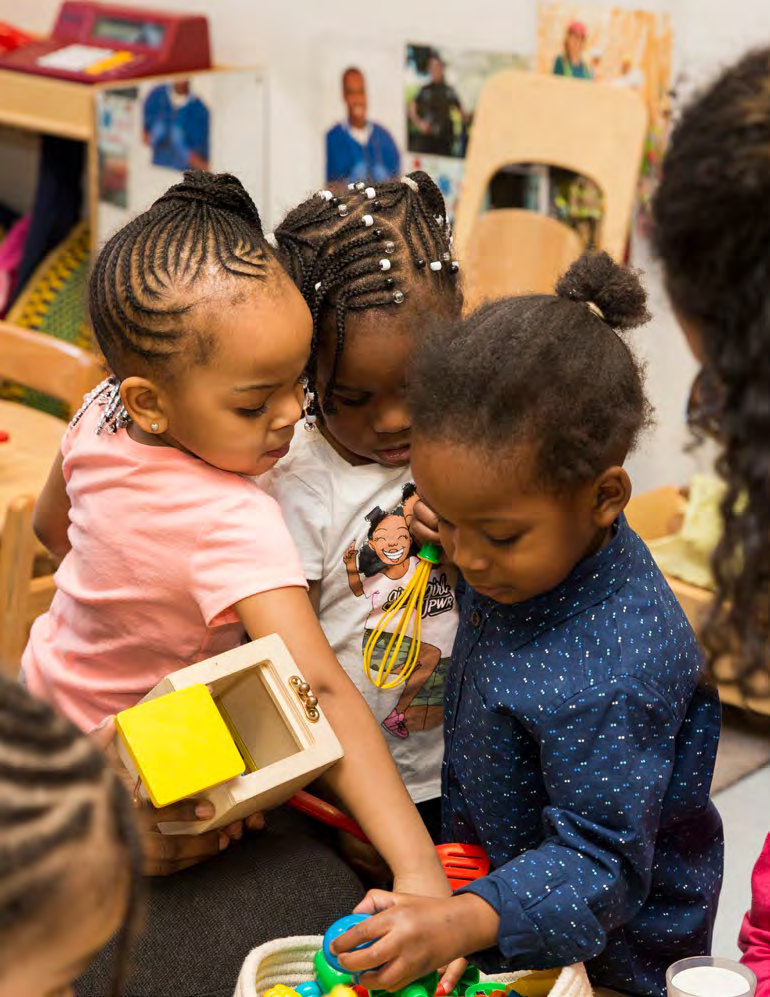
Social and Emotional Development
E
Cooperation and Negotiation
Child navigates friendships with peers through cooperation and negotiation.
0–9 months – See this age across all domains Infants
What educators might observe
- Watches babies and other children and imitates their sounds, actions, and motions
- Shows interest and enjoyment in interaction with other children and adults, as expressed in gestures, facial expressions, and vocalizations such as babbling, exclamations, and laughter
- Engages in back-and-forth interactions with the educator for short periods of time (e.g., rolling a ball, playing peek-aboo)
- Makes judgments about others by observing their helpful and unhelpful actions
- Reaches out to touch other children or the toys they are playing with
Ways educators might support the child's development
- Take time to be present with babies; acknowledge their effort to connect to you
- Provide time for babies to play near one another
- Notice when the baby is watching other children play with an object; hand the object to the baby, saying, “Would you like to hold this?” or “It’s your turn.”
8–16 months – See this age across all domains Infants
What educators might observe
- Passes a toy or a ball back and forth with an adult or another child, at least once or twice
- Imitates the simple actions of a peer (e.g., banging blocks together)
- Helps educator with caregiving tasks (e.g., holds out their foot so their caregiver can put on their shoe)
- Indicates preferences and intentions by answering yes/no questions (e.g., child nods head yes and hands a doll to teacher when asked if they are finished playing with it)
Ways educators might support the child's development
- Play back-and-forth games; for example, hand an object to a baby, wait for them to grasp it, and then reach out your hand so they may hand it back to you if they like
- Invite the baby to roll a ball to another child who rolls it back
- Provide duplicate or similar toys to avoid conflicts from arising
15–24 months – See this age across all domains Toddlers
What educators might observe
- Physically removes toys from another child’s grasp that they would like to play with
- Refuses to give peer a turn
- Accepts adult help to negotiate disputes over toys
- Expresses interest in playing with a certain child
Ways educators might support the child's development
- Provide simple tasks and toddler-sized materials so that the children may cooperate in caring for their learning environment; for example, offer children small sponges to help clean off the table
- Support children’s curiosity about other children; when a child reaches for another child, model what “gentle touches” mean and practice gentle touches on a stuffed animal
24–36 months – See this age across all domains Toddlers
What educators might observe
- Responds physically when another child takes a toy (e.g., pushing, hitting, or biting)
- Recognizes there is conflict and seeks out educator’s assistance
- Understands concept of “mine” and is starting to develop the concept of “his/hers/theirs”
- Seeks out, initiates, and responds to other children for social interactions for short periods of time
- Plays side by side with another child, making comments to them
- Participates in loosely structured group games (e.g., chase, dramatic play, or ring-a-rounda-rosie)
- Sometimes accepts and imitates other children’s ideas for play with adult prompts as needed (e.g., takes a shovel that is offered and briefly digs in sandbox beside another child)
Ways educators might support the child's development
- Respond to conflicts objectively, using simple language to describe the conflict and phrases such as, “We have a problem, so what can we do to solve it?”
- Stay with children until the conflict is resolved
- Notice and verbalize children’s feelings (“I see you really want to play with that toy and it is hard to have to wait for it.”)
- Provide alternate objects and activities while children wait for a turn
- Show respect for the child’s choices and attempts at problem solving (“Hmm, I see you want that toy and you said, ‘Turn please.’ I wonder if we could find another toy to trade with Diana?”)
3-year-olds – See this age across all domains Preschool
What educators might observe
- Negotiates with peers (e.g., takes turns, plans play) and communicates disagreement to other children
- Understands the concept of “mine” and “theirs”
- Chases other children and then turns and allows themselves to be chased
Ways educators might support the child's development
- Ensure that there are enough materials for each child to have a reasonable amount
- Observe, record, and reflect on the efforts of emergent multilingual learners to connect with their peers; intentionally create opportunities to extend these connections
- Make adaptations so that all children can be involved in a meaningful way in individual and group activities
- Create puppet shows in which conflicts between children are dramatized; allow children to identify how to solve the conflict
- Use naturally occurring problems as an example to practice problem-solving skills (“Uh-oh, we have only one of those trucks and I see that Juan is mad that Devonte grabbed it from him. What can we do to help Juan not feel mad?”)
- Provide activities that are done in pairs (e.g., “marbles in box” painting, which requires two children to hold and tilt the corners of the box)
4-year-olds – See this age across all domains Preschool
What educators might observe
- Assigns roles in play
- Uses different turn-taking strategies (e.g., bartering, trading, or waiting for a turn)
- Uses simple strategies to solve problems, either individually or in a group
- Negotiates with other children to solve a problem
- States a position with reasons (e.g., “I don’t want to play blocks right now because I want to draw.”)
Ways educators might support the child's development
-
Include books about friendship in the learning environment, such as
- Making Friends , by Fred Rogers
- Amos and Boris , by William Steig
- Alexander and the Wind-up Mouse , by Leo Lionni
- If possible, create opportunities for emergent multilingual children who share the same home language to sit and play together
- Use conflict-resolution strategies such as a problem-solving script 1. “I don’t like it when…” 2. “What can I do to make you feel better?” 3. “ You can …”
- Use visual aids to illustrate strategies for problem-solving; for example, allow children to select a picture that depicts how they feel and what will make them feel better
- Provide opportunities for the child to experience the reactions of their peers by not rushing in too quickly to resolve conflicts
5-year-olds – See this age across all domains Preschool
What educators might observe
- Shares, take turns, and cooperates in a group
- Listens to others’ ideas and wants; shares own ideas and wants
- Understands that sometimes you are a leader, and sometimes you are a follower
- Plays simple card games that require turn-taking and waiting
Ways educators might support the child's development
- Reflect with families about how they feel children should act toward their friends and siblings
- Consider peer placement during classroom activities; notice children who have been connecting with one another and place them together
-
Read books about cooperation and negotiation
- Swimmy , by Leo Lionni
- Seven Blind Mice , by Ed Young
- Anansi the Spider , by Gerald McDermott
- Encourage peer partnerships, such as play partners or clean-up buddies
- Tell the folk story of stone soup and make stone soup together as a class; discuss the value of working together
- Include child-directed activities in the daily schedule in order to give children the opportunity to learn to cooperate and negotiate
6-year-olds – See this age across all domains Early elementary
What educators might observe
- Negotiates with other children by using words to express ideas and feelings
- Plays games that have clear roles for two players (e.g., card games, board games, and computer games)
- May change the rules of structured games to ensure that they win
- Dislikes being corrected or losing at games
- Identifies actions of others as purposeful or accidental
- Sense of friendship with the same child may change abruptly within the same day
Ways educators might support the child's development
- Consider shared interest among children as basis for connection; children who like to build, children who like to read about animals, etc
- Suggest out-of-school time connections for families
- Offer shared language for respectful conversation, including respectful disagreeing: (“I disagree” rather than “No! You’re wrong!”)
-
Read books about cooperation and negotiation, such as
- Click , Clack, Moo: Cows That Type , by Doreen Cronin
- Cat and Rat , by Ed Young
- The Three Little Wolves and the Big Bad Pig , by Eugene Trivizas
7-year-olds – See this age across all domains Early elementary
What educators might observe
- Is concerned about having friends and being liked
- Engages in competitive games with peers
- Works cooperatively on a group project (e.g., a mural or group collage)
- Lets others join a game that is already in progress (e.g., “We just started playing but you can join us and go after Alex.”)
- Listens to others’ points of views and considers ways to compromise
- Identifies strategies to successfully resolve conflicts (e.g., “Let’s read the rules so we all agree on how to play.”)
Ways educators might support the child's development
-
Offer a variety of games
- Chutes and Ladders
- Go Fish, Uno, or other card games
- Jenga
- Connect Four
- Checkers
- Foster friendships; allow children to choose their own work partners at times
- Support children’s desire to spend time with peers who affirm their developing social, linguistic, and cultural identifies
- Help children generate nonviolent, assertive language to communicate; be a supportive witness as children practice these skills
8-year-olds – See this age across all domains Early elementary
What educators might observe
- Values group membership and peer acceptance
- Understands that friendships can remain even when disagreements occur
- Balances needs and rights of others and their role in group work
- Contemplates other viewpoints when resolving conflict
- Independently follows the rules of a game to ensure fair play
Ways educators might support the child's development
- When guiding children through conflict resolution, be alert to family and cultural differences in how people handle and navigate conflict
- Foster social connections among family members; ask families about times and kinds of events that would work best for them
- Notice children who may be left out and give them special jobs to do with a friendly peer; provide time to openly discuss feelings related to peer group inclusion and exclusion
- Discuss books about conflict and negotiation, asking children to name the point of conflict, feelings of each protagonist, and effective and ineffective behaviors that each character engaged in
- Offer “counselor,” a role that helps children resolve conflicts, as a classroom job