
Introduction
How to Use the Early Learning Guidelines
Each day, all day, early childhood educators make decisions about how to support children’s development.
When am I not making decisions? What to serve for snack, what book do we read, what song to sing, which child(ren) could use some one-on-one time with me, what interesting object should I put out on the welcome table, how many seats should I put at the painting table, what are important things to share with mom and dad today?
Another educator adds: Materials, placement of materials, resolving disputes between the kids, is the nap area comfortable, is the circle time long enough or short enough, are they interested in what we are learning, what book should I read? EVERY decision I make in the day affects the environment, my interactions with children, and their interactions with each other.
The Revised New York State Early Learning Guidelines can help educators to understand child development so that they can make more intentional decisions.
How can educators feel confident in their decisions and make sure their decisions are intentional?
The Cycle of Intentional Teaching and Learning is designed to be used in a play-based learning environment to guide educators’ decisions. When using the Cycle of Intentional Teaching and Learning, educators adopt a stance of curiosity about children. They think of themselves as teacher-researchers. When educators approach children with curiosity, they are less likely to be influenced by their own assumptions about what children should be doing.
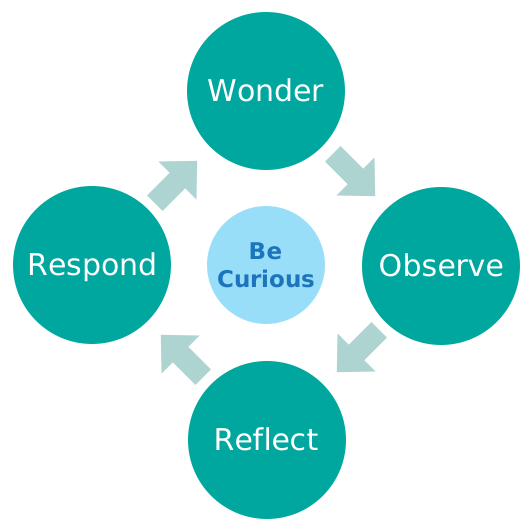
The Cycle of Intentional Teaching and Learning has four components (see Figure 1) and the Guidelines can help teachers as they engage in each component. The Cycle begins with wondering. Here educators generate questions; they think of things they would like to know about the child. The Early Learning Guidelines can assist educators in identifying areas they would like to know more about:
- I wonder how this child is cooperating and negotiating with their peers.
- I wonder who the important adults are in this child’s life. (Trusting Relationships with Adults)
- I wonder why this child speaks so much at home and so little at school. (Speaking)
- I wonder what this child is most interested in right now. (Interest and Curiosity)
The next step is to observe children’s learning. When educators observe, they step back, notice, and record what is happening to answer their question. They try to be objective by focusing on who, what, where and when, rather than why something is happening. There are many ways to do this:
- Photos
- Videos
- Work samples (drawings, paintings, block buildings)
- Written observations
- Voice recordings
- Transcriptions of children’s language
- Family observations and stories
All of these records of children’s development are referred to as documentation. A sample observation template is included in the Appendix.
Next educators reflect on their observations. They spend time looking at and thinking about the documentation. They also share the documentation with children’s families and their teams to deepen their understanding of the child’s development. During this step, educators use the Early Learning Guidelines “What the educator might observe” sections to compare their documentation to the sample observations. What have they found out about their original question? Where is this child on their unique developmental pathway? How does the child’s culture emerge from what they see? This is the time when educators and families might talk about why the child is doing something.
The final step in the Cycle of Intentional Teaching and Learning is to respond. Educators can use the “Ways the educator might support the child’s development” sections of the Early Learning Guidelines to make an intentional decision about what to do next. They might:
- Engage in self-reflection.
- Plan to learn more from families.
- Plan what to do the next time that happens
- Plan what to say the next time that happens
- Change the environment
- Change the schedule
- Choose a book to read
- Plan an activity
- Plan an outing or simple trip
- Gather materials for an art experience
- Share documentation, reflections, and ways to extend learning with families and the school community