
Communication, Language, and Literacy
A
Speaking
Child will develop the ability to speak and/ or sign in increasingly complete, complex, precise, and varied ways.
0–9 months – See this age across all domains Infants
What educators might observe
- Sucks on fingers or pacifiers and moves head and mouth towards milk
- Laughs and chuckles
- Cries when hungry, upset, or in need of attention
- May repeat cooing sounds, such as “ooh” and “ah”
- Watches caregiver’s mouth closely as they are talking
- May sign “milk” by hand gesture approximating the opening and closing hand
- Babbles and may make “p,” “b,” and “m” sounds that can begin to seem like “papa,” “baba,” or “mama”
- Holds up arms to be lifted up or for a hug
Ways educators might support the child's development
-
Talk to the baby
- Use the baby’s home language, if possible
- Imitate and repeat the baby’s vocalizations, making meaning of sounds like “ma-ma” and “da-da”
- Read and sing in home language/language varieties
- Tell the infant stories, especially about their day
- Repeat rhymes and songs from the infant’s culture and in-home language(s)
- Describe what you are doing during caregiving routines
- Narrate the baby’s feelings
- Listen for comfort sounds to discover the things that help the baby feel good and secure
- Respond to the baby’s cry as soon as possible; listen for the differences in the baby’s cries and sounds: is the baby crying because they are in pain, hungry, wet, or in need of attention?
8–16 months – See this age across all domains Infants
What educators might observe
- Uses facial gestures to engage with adult, such as blinking eyes or sticking out tongue
- Makes physical contact to get educator’s attention, including holding educator’s face in their hands or patting educator’s leg until attention is given
- Uses utterances consistently to refer to people or favorite objects (e.g., ”Mama” for mother, “Dada” for father, and “Ba-ba” for blanket)
- Uses a few words to express needs and wants that are understood in context by adults in the child’s environment (e.g., saying “up” to indicate desire to be held) Note: Expressive language development may pause as a child learns to walk and increase their mobility
Ways educators might support the child's development
- Talk with families about what they notice about their children’s language development at home
- Invite families who speak a different home language to teach you a few key words
- Learn and sing songs and rhymes in the home languages of the children in your class
- Play “peek-aboo” and engage in face-to-face play as well as noseto-nose games with giggles, laughs, coos, and babbles that become words
- Sing throughout the day; incorporate the baby’s babbles and favorite words into songs that you make up
15–24 months – See this age across all domains Toddlers
What educators might observe
- Points to items that they want or want the caregiver to give attention to
- Uses two words together to express wants, needs, or ideas, such as “Papi, go.”
- Shakes head “no” in response to questions
- Uses made-up words to refer to familiar objects and experiences that family members and educators understand
- Uses some words to refer to more than one thing (e.g., “wowa” may mean both sitting in the stroller and going outside)
- Adds new words to their vocabulary every day
- Socializes and interacts with peers using nonverbal (gestural) means, along with words or phrases (e.g., making a motion to push another child away and saying, “Go Away.”)
Ways educators might support the child's development
- Include books in the learning environment that represent the home languages or language variations and cultures of the children
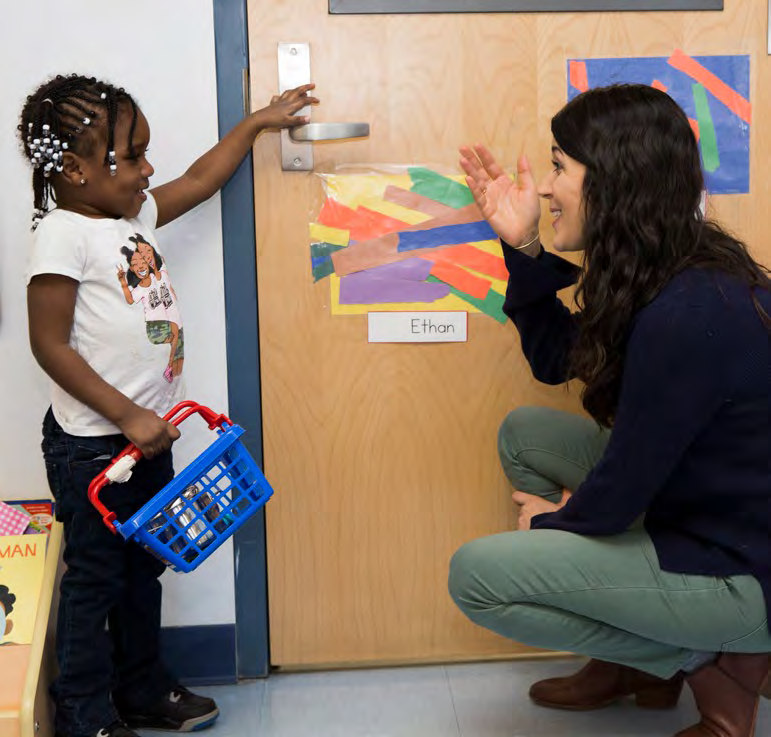
- Bend down to the child’s level when they are talking to you
- Use children’s names when you talk to them
- Create a language-rich environment with many opportunities for back-and-forth interactions
- Keep sentences short and to the point (“I see that you are playing with the ball. Oh look, Carl is also playing with the ball!”)
24–36 months – See this age across all domains Toddlers
What educators might observe
- Puts two or more words together to express more complex thoughts (e.g., “All gone bubbles,” “Mommy eat,” “I want,” or “I no want.”)
- Uses past tense in simple sentences that may contain errors, such as “I goed to school.”
- Uses the possessive, though not always correctly, (e.g., “Her Julia.”)
- Starts to label different items with an adjective such as a big chair or blue ball
- Emergent multilingual learners will play with using more than one language in a single sentence or conversation (e.g., “More leche please.”)
Ways educators might support the child's development
- Encourage families to read, sing, and play with their child in their home language
- Have meaningful conversations with the child; notice what they are thinking and talk to them about it
- Pause and wait for the child to respond to your questions
- Demonstrate that you are committed to understanding children who speak a different home language than you
- Reflect on personal biases and assumptions about “proper speech.” Ask families about words and grammar from language variations with which you are unfamiliar
3-year-olds – See this age across all domains Preschool
What educators might observe
- Asks questions such as “ ¿Quieres jugo? ” (“Do you want juice?”) along with “when” and “how” questions
- Answers “who,” “what,” “where,” and “when” questions in preferred language (e.g.,“ Vivo en Nueva York. ” [“I live in New York.”])
- Uses some pronouns correctly, such as “I,” “you,” “me,” “he,” and “they”
- Uses some plural words, like “toys,” “birds,” and “buses”
Ways educators might support the child's development
-
Conduct a home language survey at the start of the year and ask families
- What languages does the child speak and understand?
- What languages does the child speak to their siblings?
- In what language does the child play with peers?
- What has the child’s exposure to English been?
-
Set up the dramatic play area to resemble home and real-life situations to guide and promote language
- Include details such as a tablecloth and flowers on a table
- Turn the area into a laundromat, fire station, or other community location
- Ask families to bring in empty boxes of food to include in dramatic play
- Include items that are specific to children’s home cultures
4-year-olds – See this age across all domains Preschool
What educators might observe
- Uses past and future tenses (“Yesterday we went to the park, where I’m gonna have my birthday party!”)
- Talks about a variety of topics for different purposes
- Demonstrates more complex sentences and precise vocabulary in areas of interest, explaining, for example, “No, that’s not a digger, it’s an excavator!”
- Emergent multilingual learners may ask to participate in activities using short sentences or approximations, for example, “Can I play?” or “I play?”
Ways educators might support the child's development
- Learn and use key phrases in the home language of the children
- Sing songs, chants, rhymes, and finger plays in English and the home language to help children learn common phrases and words through music
- Repeat new and interesting vocabulary in different settings and times throughout the day
- Allow children to use translanguaging, which involves using their home language and English interchangeably; children should be encouraged to access all languages available to them
- Sit with children during snack and lunch time to model language and encourage conversation
5-year-olds – See this age across all domains Preschool
What educators might observe
- Initiates and maintains a conversation with peers for exchanges over longer periods of time
- Talks about language, as in “I know Spanish,” or “I think that is what you said.”
- Responds to the question, “What did you say?”
- Uses increasingly complex sentence structure to express thoughts (“I am going to the hospital, but I’m pretending. I’m not going to have the baby. The mommy is going to have the baby.”)
- Talks in different ways depending on place and listener
- Tells simple stories
Ways educators might support the child's development
- Set up your library with books in multiple languages
- Value and make time for extended conversations, and engage in one-to-one exchanges around children’s interests and questions
-
Ask open ended questions:
- Why do you think…?
- What happened when…?
- What would happen if…?
- What is the story in this picture?
6-year-olds – See this age across all domains Early elementary
What educators might observe
- Speaks clearly so that others understand
- Tells a joke to a friend
- Uses most parts of speech or grammar correctly (e.g., uses a contraction)
- Uses vocabulary specific to science, math, social studies, and the arts
Ways educators might support the child's development
- Provide opportunities for children to engage in informal talk throughout the day
- Provide opportunities for children to use new content area vocabulary in conversation and with their family by sending home conversation starters (e.g., “Ask your child about the geodes we opened today in science.”)
- When children are engaged in a content area like visual arts, repeatedly use vocabulary specific to their processes, such as “perspectives” and “dimensions”
7-year-olds – See this age across all domains Early elementary
What educators might observe
- Speaks clearly, modifying volume so that all listeners can understand
- Asks and answers “who,” “what,” “when,” “where,” and “why” questions about an topic of interest
- Refines vocabulary so it better expresses the meaning that they want to express
- Categorizes vocabulary by parts of speech
- Enjoys puns
- Artfully combines English with home language(s) to better convey meaning, play with language, and/or strengthen relationships
Ways educators might support the child's development
- Use translanguaging with children, and scaffold their use of academic language by strategic use of home language and English
- Learn key words in the child’s home language related to the topic of study
- Draw on cognates in both English and the child’s home language
- Provide opportunities for children to represent the meaning of words in a variety of ways (e.g. through dance, in song, or in a drawing)
8-year-olds – See this age across all domains Early elementary
What educators might observe
- Expresses an opinion or point of view on a story, referring to relevant examples or details
- Summarizes a text in a retelling
- Uses a wide range of vocabulary specific to academic subjects to explain what they learned in school
- Uses their knowledge of home language to find cognates in English
Ways educators might support the child's development
-
Choose a sentence that has a complex structure
- Engage in word play by altering the vocabulary in the sentence
- Chart sentence and unpack meaning
- Use sentence starters to practice making new sentences with a similar structure
- Research the bases and parts of words with children; look for and point out meaning in the structure of words