
Physical Well-Being, Health and Motor Development
A
Large Motor Skills
Child uses and coordinates their large muscle groups.
0–9 months – See this age across all domains Infants
What educators might observe
- Holds head upright and in middle of body when carried
- Brings hands together while lying on their back
- Lies on their back and holds onto their feet
- Rolls from back to front
- Rolls from front to back
- Sits unsupported and reaches for objects
- Moves from sitting to hands and knees
- Rocks back and forth on their hands and knees
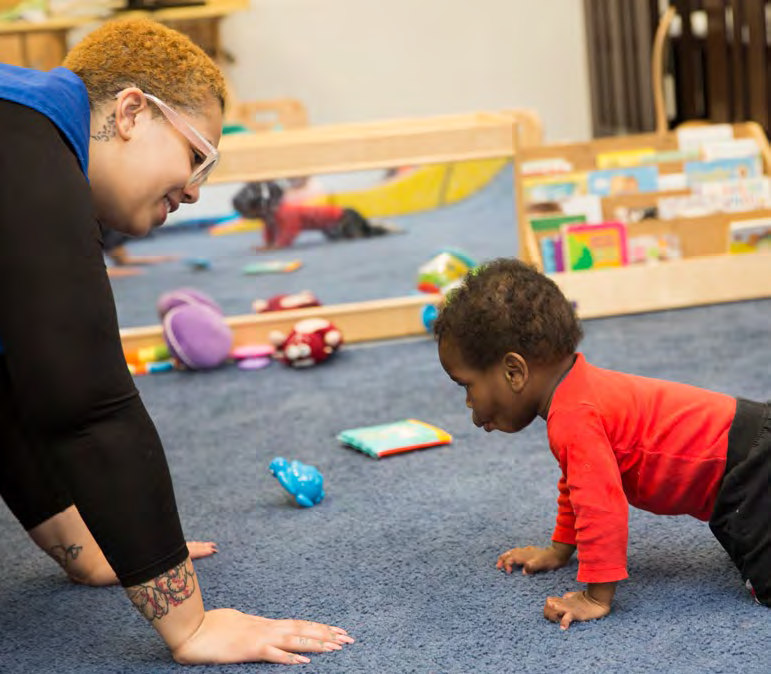
- Pulls body forward while on stomach (commando crawl)
Ways educators might support the child's development
- Dance with the baby in your arms so they can feel your movements and begin to move with you
- Place infant in front of a mirror so that they can see the different ways that they move
- Create spaces, places, and times for whole body play and movement
- Place babies on their abdomen with toys placed within sight but slightly beyond their reach; recognize the baby’s efforts to move toward the toys by saying such phrases as, “You really worked very hard to reach that toy and now you have it!”
- Respect babies’ sense of dignity and autonomy by allowing them to move freely in the ways that they would like; avoid furniture that limits babies’ movements such as bouncers and walkers
8–16 months – See this age across all domains Infants
What educators might observe
- Moves between lying down, sitting, and balancing on hands and knees
- Crawls
- Pulls to a standing position
- Sits back down and moves to crawling after sitting down
- Pulls to standing, and uses one hand to manipulate toys
- Cruises (walks holding on to furniture)
- Adjusts body position when moving up or down slopes or along different surfaces
- Crawls up the stairs
- Starts to walk around tables with support
- Pushes a doll stroller or other wheeled object while walking
- Walks without support
- May walk a bit and then suddenly sit down
- Stops walking, squats, and stands back up
- Throws a ball
Ways educators might support the child's development
-
Create an indoor learning environment that provides opportunities for children to develop their large motor skills
- Open spaces where new walkers can practice walking back and forth
- Different levels so that children are able to pull themselves up on something
- Mats or rugs for rolling and stretching
- Large baskets and boxes for crawling in and out of
- Create schedules in which children are able to move their bodies freely whenever they are not engaged in caregiving routines
15–24 months – See this age across all domains Toddlers
What educators might observe
- Runs
- Kicks a ball
- Climbs onto an adult-sized couch
- Walks up and down stairs while holding onto an educator’s hand
- Walks up and down stairs or climbing equipment by stepping with both feet on each step
Ways educators might support the child's development
- Create outdoor spaces that are safe for young toddlers to freely explore
-
I nclude large motor furniture in the indoor learning environment
- Small slide
- Steps with platform
- Rocker boat/ bridge
- Tunnel
- Large blocks made of wood or cardboard
24–36 months – See this age across all domains Toddlers
What educators might observe
- Changes speed or direction while moving though may have difficulty stopping with control
- Walks up stairs, placing one foot on each step
- Bends over to pick up a toy and stands back up
- Jumps forward with both feet at the same time
- Walks on tip-toes when asked
- Climbs a playground ladder
- Catches a medium-sized ball
- Pedals a tricycle
Ways educators might support the child's development
- Play ball with children, introducing concepts of taking turns, catching, and throwing
- I ntroduce action songs such as, “Animal Action,” “Sammy,” and “We’re Going on a Bear Hunt”
- Give children opportunities to walk barefoot on different surfaces, such as carpets, wood floors, linoleum floors, sand, concrete, or soft matting
3-year-olds – See this age across all domains Preschool
What educators might observe
- Walks along curb or beam for short periods
- Jumps off a step with both feet together
- Throws ball overhand
- Catches mediumto large-size balls and similar objects by trapping them against body with straight arms
- Climbs up playground ladders
- Gallops
- Has a smooth walk/run gait
- Can stop body before running into other peers o obstacles
- Runs and stops suddenly without falling
Ways educators might support the child's development
-
Provide access to playground materials that support the development of gross motor skills
- Balls of various sizes
- Ribbon dancers
- Tricycles
- Scooters
- Low steps
- Large blocks
- Balance beams
- If possible, take children on walks in nature during which they have the opportunity to walk on different surfaces and climb over rocks and logs
4-year-olds – See this age across all domains Preschool
What educators might observe
- Runs smoothly around obstacles, stops and starts, plays tag
- Jumps for height and distance
- Hops on one foot
- Balances on one foot for a few moments
- Pedals tricycle while navigating corners and obstacles
- Walks up and down stairs, alternating feet, without support
- Climbs down playground ladders
- Squats without falling over
Ways educators might support the child's development
-
Play games with children that facilitate the development of gross motor skills, such as
- Simon Says
- Freeze tag
- Hokey Pokey
- Head, Shoulders, Knees, and Toes
- Red Light, Green Light
- Songs with dance steps that include galloping, skipping, and walking in rhythm
- Provide times in the daily schedule for both structured and unstructured gross motor activity
5-year-olds – See this age across all domains Preschool
What educators might observe
- Skips using alternating feet
- Walks backwards
- Turns somersaults
- Catches a playground ball from 3 feet away
- Balances on either foot
- Walks up and down stairs while holding an object
- Moves confidently around an obstacle course, maintaining balance while stopping and turning
Ways educators might support the child's development
-
Provide access to playground materials that support the development of gross motor skills
- Hula Hoops
- Basketballs
- Soccer balls
- Large wooden blocks
- Jump ropes
6-year-olds – See this age across all domains Early elementary
What educators might observe
- Kicks a ball at a target
- Pumps legs to swing
- Rides a bicycle without training wheels
- Jumps rope
- Dribbles basketball a few times
Ways educators might support the child's development
-
Sing songs or chants with some dance steps to practice galloping, skipping, side stepping, walking in rhythm, such as
- “Skip to My Lou”
- “Going to Boston”
- “El Juego Chirimbolo”
- “Sasha 1-2-3”
- “Little Johnnie Brown”
- “Funga Alaffia”
- Provide structured gross motor breaks throughout the day
- Provide unstructured, outdoor recess time each day
7-year-olds – See this age across all domains Early elementary
What educators might observe
- Runs up and down stairs with alternating feet
- Runs to catch moving ball
- Turns cartwheels
- Swims
- Learns a series of dance steps
- Swings bat and hits ball
Ways educators might support the child's development
- View recess as a right, not a privilege
- Teach playground ball games such as kickball, foursquare, and tetherball
- Create opportunities for children to choreograph sequences of movements
- Organize competitive games with children and model sportsmanship
8-year-olds – See this age across all domains Early elementary
What educators might observe
- Shows good form in basic movement even when participating in fast-moving games
- Dribbles ball forward
- Runs forward while tossing a ball back and forth with a peer
- Mirrors partner’s movements in a dance
- Tosses a ball to themselves and hits it with a bat
Ways educators might support the child's development
- Talk to families about the importance of gross motor play during out-of-school time
- Connect families to local opportunities to participate in sports (e.g., soccer leagues, local playgrounds, public swimming pools)
- Create opportunities for children to learn and practice dances from their families’ communities and cultures