
The trusting relationships that children form with responsive adults in infancy and early childhood lay the foundation for all the learning that will come later. The baby’s favorite thing to look at is their mother, father, or other significant family member’s face, and their favorite sound to listen to is that person’s voice. The baby is completely attuned to the person they are depending on to meet all of their physical and emotional needs. Through predictable and loving interactions, babies develop secure attachments to their family members and educators. They are able to confidently explore the world because their beloved people are there for them.
Early attachment relationships are critically important. They predict children’s ability to grow into resilient adults, who can regulate their emotions, engage in interactions, and resolve conflicts. Early childhood educators form trusting relationships with children when they notice and attend to children’s physical, emotional, and learning needs. Educators can also support the development of the child’s healthy attachment relationships to their family. They do this when they respectfully acknowledge the family as the expert on their child’s development and promote the family’s positive feelings about their child.
Children with strong attachment relationships learn, over time, to regulate their feelings. They develop the ability to express a socially and culturally acceptable range of feelings. When children have insecure early attachments, they feel the need to test the security of all of their relationships. They may have learned that expressing themselves results in negative reactions, causing insecurity, mistrust, and fear. Educators support children’s self-regulation by being warm and reassuring and providing the predictable limits and consistent routines children need to feel safe. Educators can prepare to care for children by taking good care of themselves, resting and eating well, reflecting with trusted colleagues, and asking for help when they need it.
Children travel between the social worlds of their home and their learning environment. It is important for their emerging sense of self that they feel they belong in each place. For many children, the cultural values and expectations of home are very different from those of the learning environment. For example, early learning environments often promote independence and self-sufficiency. This is evident in expectations that children will be able to care for themselves and put themselves to sleep from an early age. Many families value helping one another and think that it is right for older people to assist and comfort younger ones. Educators can promote children’s positive sense of self and belonging by engaging in ongoing two-way communication with families to align their expectations, values, and caregiving practices.
As children enter the preschool and primary years, their relationships with other children become increasingly important to them. Social skills, such as empathy, cooperation, and negotiation, are developing at this time. Modeling social skills is important at this age, as children learn from educator’s own efforts at self-regulation and conflict resolution.
The Pyramid Model in New York:
Early childhood leaders in New York State identified a critical need to better support and teach young children and families social and emotional skills. In response, the New York State Council on Children and Families took the lead in 2015 to bring together a team of public and private agencies to form a Pyramid Model State Leadership Team to guide the implementation across the state. The New York State Pyramid Model Leadership Team is promoting the statewide use of the Pyramid Model, an evidence-based framework proven to be an effective approach to building social and emotional competence in all early care and education settings. For more information please go to New York State Pyramid Model (opens in a new tab).
Goals
- Increase the number of early childhood trainers and coaches providing professional development to the early childhood workforce on the Pyramid Model practices to meet the social and emotional development needs of young children
- Support partnerships between educators and families
- Eliminate the suspension and expulsion of children under six in New York
- Support the implementation and sustainability of the Pyramid Model in all early childhood settings
- Evaluate the effectiveness of implementing the Pyramid Model in New York State
The “ways the educator might support the child’s development” sections of the Early Learning Guidelines are aligned with practices endorsed by the Pyramid Model. They are designed to create learning environments in which every child feels they belong; promote children’s social engagement and positive relationships; and teach children routines, expectations and problem-solving strategies that will help them to be successful.
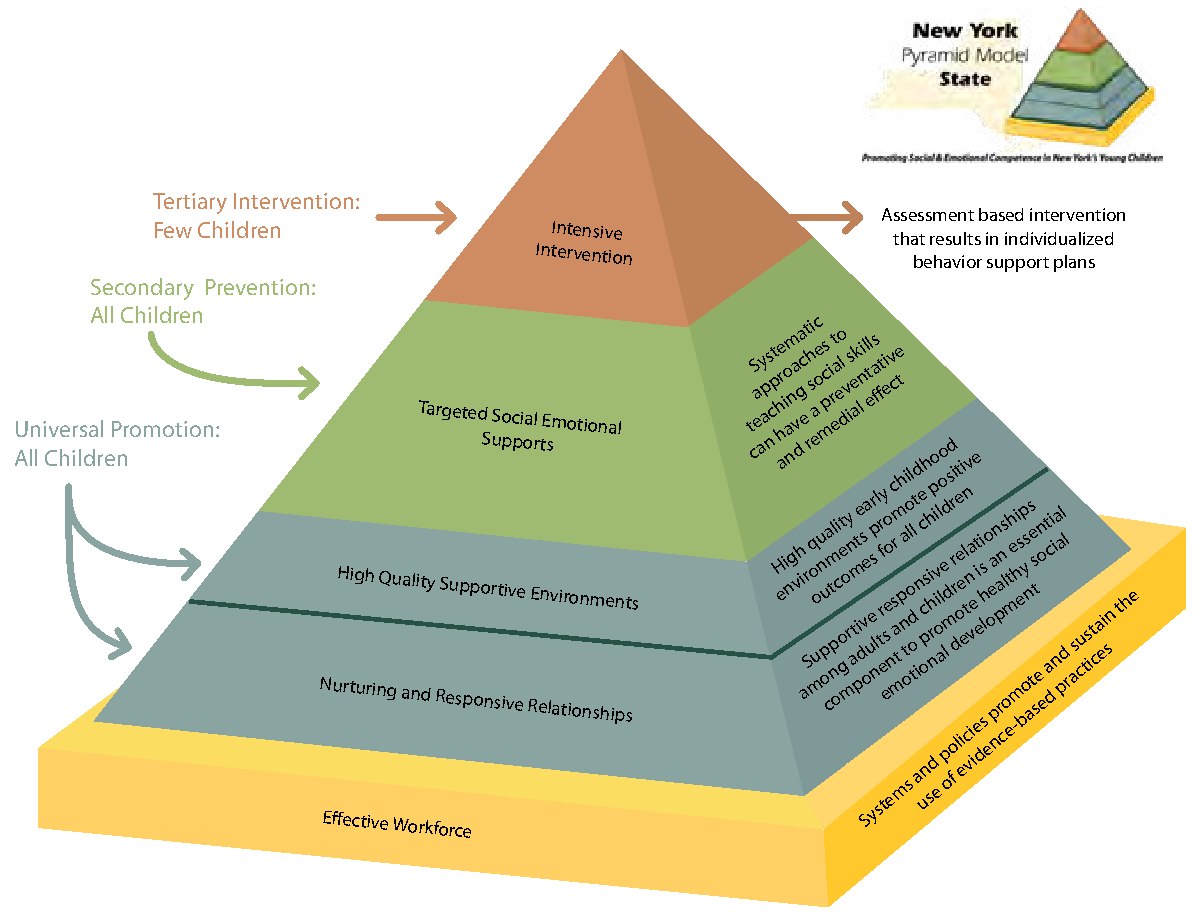
Text description
The pyramid rests on a foundation labelled Effective Workforce: systems and policies promote and sustain the use of evidence-based practices.
From bottom to top, the tiers are:
Nurturing and Responsive Relationships (Universal Promotion: all children). Supportive responsive relationships among adults and children are an essential component to promote healthy social emotional development.
High Quality Supportive Environments (Universal Promotion: all children). High quality early childhood environments promote positive outcomes for all children.
Targeted Social Emotional Supports (Secondary Prevention). Systematic approaches to teaching social skills can have a preventative and remedial effect.
Intensive Intervention (Tertiary Intervention: few children). Assessment-based intervention that results in individualized behavior support plans.